

Done right, Facebook Ads for plastic surgeons can drive the lowest cost per lead of any paid marketing channel available today.
However, when poorly executed, Facebook and Instagram ads often result in a flood of clicks who either cannot afford your procedures or simply do not trust your expertise.
This guide will walk you through:
- Why Facebook Ads are a non-negotiable part of a modern plastic surgery clinic’s marketing mix.
- How to structure your campaigns to attract the right patient for your specific practice.
I’ve been running a marketing agency for plastic surgeons since 2017. We’ve had our wins and our failures.
Meta Ads pretty consistently drives leads as long as:
- Your creative is set up the way it should be
- Your landing page is optimized to convert
- Your positioning and messaging is dialed in
Let’s get into it.
How Facebook Ads Fit Into Overall Plastic Surgery Marketing
For years, plastic surgeons have relied heavily on Google Ads to drive new patient inquiries.
While Google is excellent at capturing “in-market” demand, it is fundamentally limited by search volume and the face that Google Ads only gets in front of patients already actively searching for a specific procedure or a surgeon.
This means you are competing for the 3%-20% of the market that has already decided to take action:
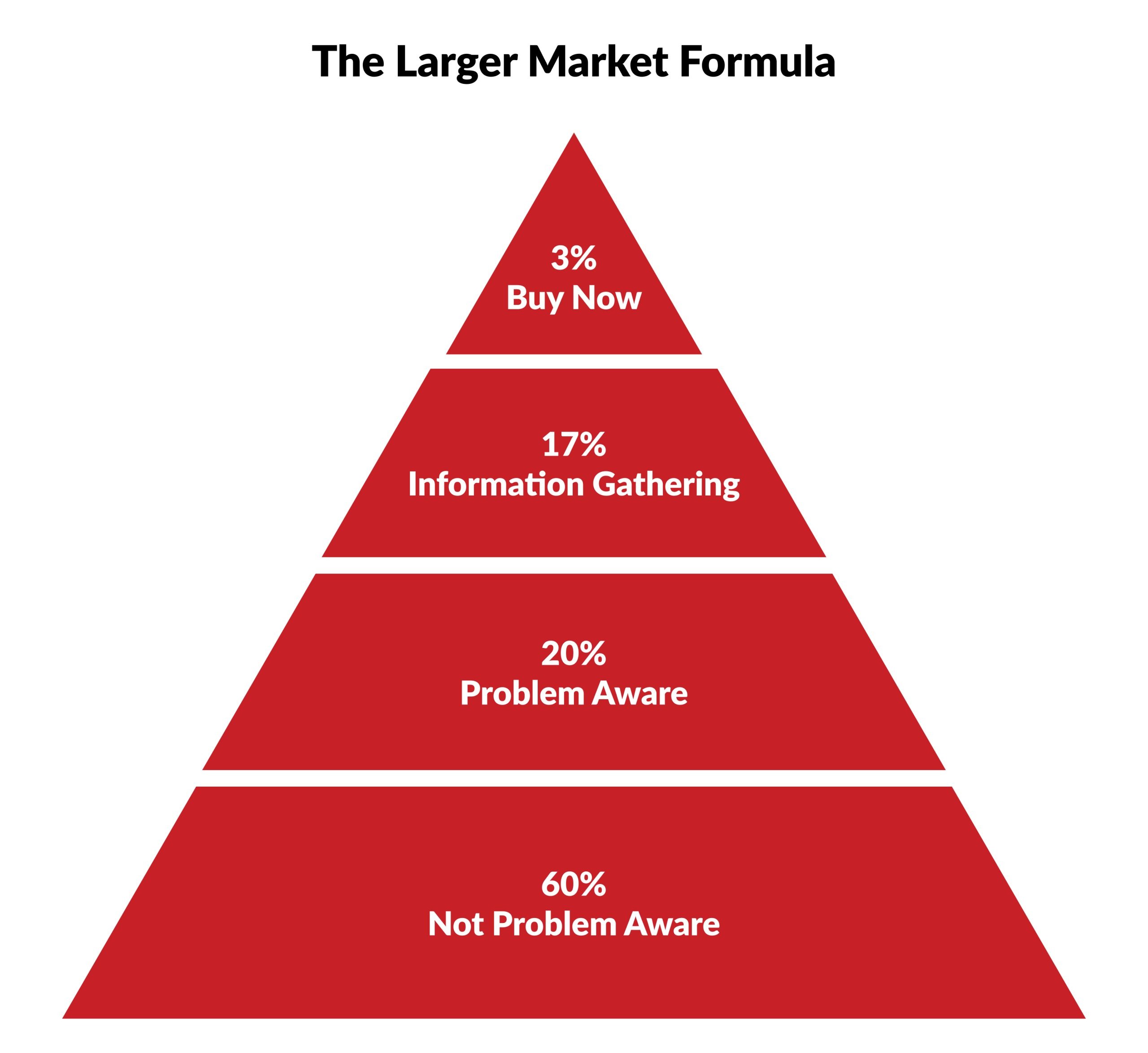
Meta Ads (Facebook and Instagram) allow you to flip this script by creating intent rather than just capturing it.
Meta’s algorithm can identify potential patients based on their interests and behaviors long before they ever type a query into a search bar.
This proactive approach is far more scalable than any organic channel or word-of-mouth referral program.
It gives you a “lead valve” that you can turn up or down based on your surgical schedule.
In this guide, we will walk you through the approach to Meta Ads for plastic surgeons that drive high-quality surgical leads for as low as $40.
The 3-Tier Campaign Structure for Scalable Patient Acquisition
A successful Meta strategy isn’t a single ad; it is a journey.
Top of Funnel (Prospecting): The Education & Awareness Phase
At this stage, we are not asking for a booking yet.
We use Broad Targeting via Meta’s Advantage+ audiences to find users with a latent interest in aesthetic self-improvement.
The core of this stage is the Video Sales Letter (VSL).
This is a recorded video where you, the surgeon, explain a specific procedure in detail.
You aren’t just selling; you are educating the “future patient” on the “why” and “how” of the surgery.
This ad drives traffic to a dedicated landing page designed specifically to inform, not just convert.
Middle of Funnel (Consideration): Building Surgical Authority
Once a user has watched your VSL or interacted with your initial ad, they enter the “Consideration” phase.
Because of privacy regulations, we use the Engagement Loophole.
Instead of tracking them across the web with a pixel, we target them based on the fact that they watched 50% or more of your video on Meta’s platform.
This is 100% HIPAA-compliant because the data never leaves Meta’s servers.
At this stage, we are specifically targeting those individuals who engaged with your top-of-funnel VSL.
In this phase, we show them authority-building content, such as clips of you in the office or explaining the patient journey.
Bottom of Funnel (Decision): Capturing the Consultation
By the time a user reaches this stage, they are “pre-educated.”
They understand the procedure, and they trust your expertise.
Now, we serve a direct-response ad only to those who have engaged deeply with the previous layers of your funnel.
The call to action is clear: “Schedule a Private Consultation.”
It is important to note that Meta does not like before-and-after images in the actual ad creative for cosmetic surgery.
Using them can lead to ad account bans, so we save those transformations for the landing page.
Testing Is the Path to Profitable Facebook Ads
High-impact creative is the difference between a $40 lead and a $400 lead.
We utilize the 3-2-1 Creative Testing Framework.
This involves testing three different emotional hooks (e.g., Confidence, Restoration, and Youthfulness) across two formats (Reels and Static Images).
The goal is to find the one “winning” combination that resonates most with your local market.
When writing your copy, we strongly believe in Clinical Honesty.
Avoid “puffery” or over-promising results.
Be straightforward with patients regarding pain levels and recovery times.
Patients actually respect a surgeon who is honest about the “downside” of a procedure.
This transparency builds immense trust and ensures that the leads you do get are serious, informed adults.
Solving the “Low-Quality Lead” Problem
Many surgeons complain that Meta leads are “terrible” or unresponsive.
If you are seeing low-quality leads, you likely have one of three problems: your creative, your landing pages, or your positioning.
Bad Ads
If your ads look “cheap” or focus heavily on deep discounts, you will attract price-shoppers who cannot afford the surgery.
If you’re the cheap option in your market, then great!
If you’re the premium option, your ads and clinic need to feel premium.
Part of that is simple messaging.
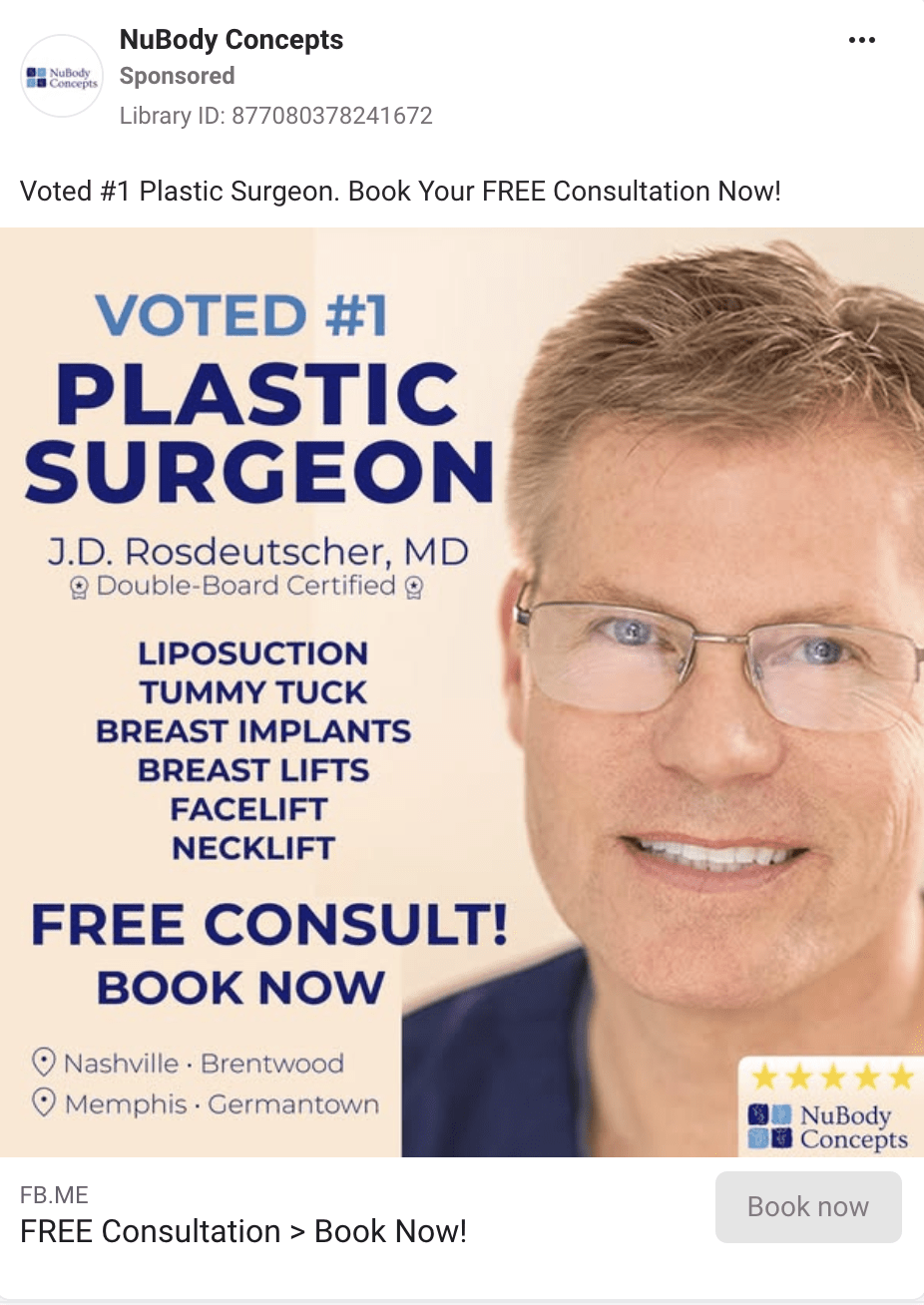
Look how cluttered this is (and not to mention the misspellings and grammar errors):

The Landing Page Filter
We advise against using Meta’s native “Lead Forms” because they are too easy to fill out, leading to low-intent leads.
Instead, we send traffic to a landing page with a qualifying questionnaire.
Asking five or six specific questions about their goals and timeline filters out the “window shoppers.”
Compelling Before & Afters
While Meta restricts these in ads, they are essential on your landing page.
Make sure they are clear and compelling.
If the results are too subtle, users may scroll past them and bounce from the site.
Choose Your Positioning—And Stick With It
No one wants sushi from a pizza place.
A similar principle applies to plastic surgery practices; if you claim to be good at everything, prospective patients will think you’re good at nothing.
Your marketing must have cohesive messaging that focuses on a few procedures you do exceptionally well.
No one wants a generalist for a rhinoplasty; they want the specialist.
Ensure your website, social media, and ads all align with your chosen focus. Leave no room for confusion.
Budgeting and Scaling: Controlling Your Growth
Scaling a practice requires understanding how to manage your “Lead Valve.”
We use Campaign Budget Optimization (CBO) to let Meta’s AI automatically move money toward the procedure-specific ads that are performing best.
If your Rhinoplasty ads are converting at half the cost of your Tummy Tuck ads, CBO will automatically shift the spend.
Vertical Scaling involves increasing the budget on your winning ads by 20% every few days.
Horizontal Scaling involves taking a winning ad and launching it in a new geographic area or targeting a new demographic.
Maintaining HIPAA Compliance and Patient Privacy
The standard Meta Pixel is a legal risk for plastic surgeons.
Sending data about the pages your patients visit on your website back to Meta constitutes a HIPAA violation.
You can avoid this using the Meta Conversions API (CAPI).
CAPI allows your server to tell Meta that a conversion happened without sharing the person’s identity.
For small practices, the safest move is to disable standard website retargeting entirely to avoid potential fines.
Instead, rely on the “Engagement Loophole” mentioned earlier—retargeting based on video views and platform interactions.
This keeps you fully compliant while still allowing you to stay top-of-mind with interested prospects.
Performance Optimization and Lead Management
Success in Meta Ads is measured by the Appointment Show Rate, not just “Likes.”
You must track your Cost Per Lead (CPL) against your surgical revenue to find your true ROI.
Finally, you must follow the 12-Hour Lead Rule.
If your staff does not follow up with a lead within 12 hours (or ideally, 15 minutes), the lead quality will plummet.
Integrate your Meta Ads directly with your CRM to ensure no potential patient falls through the cracks.
A Predictable Future for Your Practice
Meta Ads allow you to stop waiting for patients to find you and start bringing them to your door.
By following a “Privacy-First” technical setup and an education-heavy funnel, you can build a sustainable lead machine.
Remember: be the specialist, be honest about results, and always protect your patients’ privacy.


