

Your med spa is doing somewhere between $40,000 and $150,000 a month.
Money is going out the door every month — an Instagram you post to, a website somebody built two years ago, maybe an agency sending you a report you skim. And if someone asked you today which of those produced last month’s consults, you’d be guessing.
That’s not a discipline problem. Almost every medical spa marketing guide online lists the same six channels — SEO, social, email, paid search, paid social, reviews — tells you they’re all important, and never once tells you what a patient costs to acquire on any of them.
You can’t make a budget decision out of that.
This guide to med spa digital marketing is built the other way around. It covers the channels, but it’s organized around three arguments that most practices get wrong:
- Your before-and-afters and your booking flow decide whether any traffic converts. Fix those before you buy a single click.
- On paid channels you’re buying a repeat patient, not a first visit. With Google Ads for injectables you will almost always be in the red until that patient comes back. Your competitors know this. It’s why they can outbid you.
- Channels compound into each other. The return on any one of them depends on how the others are doing, which means budgeting them as separate line items understates every one of them.
Everything below ladders back to one of those three.
What med spa digital marketing actually has to accomplish
Digital marketing for a med spa has three jobs, and most practices are only doing the first one.
Fill the calendar this month. Paid search, paid social, promotions to your existing list. This is the job everyone thinks marketing is.
Build a presence that compounds. Organic rankings, a review base, a following, a website that gets better at converting over time. This is the job that decides what your marketing costs in year three.
Raise the value of patients you already have. Rebooking, adding a second service line, converting to a membership. This is where the money actually is in an aesthetics practice, and it’s the job most commonly ignored — because nobody sends you an invoice for not doing it.
The funnel connecting them is short and every step leaks: someone discovers you, books a consult, actually shows up, buys a treatment, and then either comes back or doesn’t. A 20% improvement at any one of those steps does more for your revenue than a 20% budget increase. Keep that in mind as you read the channel sections, because channels only address the first step.
The economics: what a med spa patient costs to acquire
Here’s the metric problem. Agencies report cost per lead. Owners need cost per treated patient. Those are separated by two conversion rates that nobody talks about in the sales meeting.
A lead is a form fill. Between that and revenue sits whether the consult gets booked, whether the patient shows, and whether they buy. A $40 lead with a 30% show rate is more expensive than a $90 lead with an 85% show rate, and if your agency only reports the first number you will make the wrong call every time.
So track three:
- Cost per lead — what you paid for contact information
- Cost per booked consult — cost per lead ÷ booking rate
- Cost per treated patient — cost per booked consult ÷ (show rate × close rate)
Why the acceptable number is different for every treatment
The second half of the equation is what a patient is worth, and in a med spa that varies enormously by what they came in for.
A neurotoxin patient has a natural 3-to-4-month repeat interval built into the pharmacology. They will be back, predictably, for years, and they’re the most likely of any patient type to add a second service. A body-contouring patient might spend more on day one and never return. A GLP-1 weight-loss patient is on a monthly cycle for as long as they stay on protocol. A laser hair removal patient buys a package, completes it, and is done.
Those are not the same patient, and they cannot justify the same acquisition cost. The spread in twelve-month value across service lines is wide enough that a budget which is reckless for one treatment is conservative for another.
The rule that falls out of it: your allowable acquisition cost is a function of twelve-month contribution margin, not first-visit revenue. Which brings us to the argument that matters most.
Stop trying to make paid ads profitable on the first visit
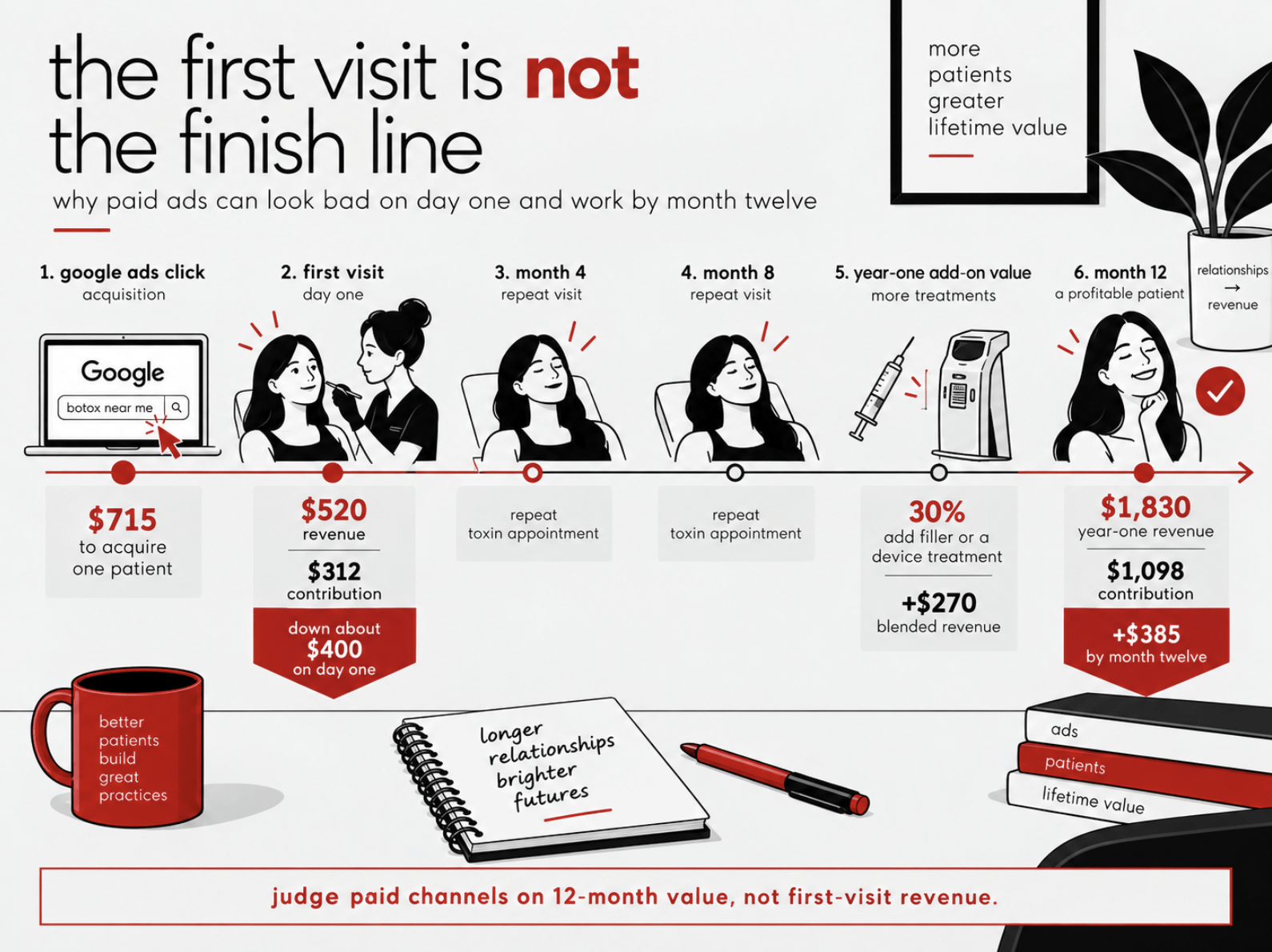
This is where most med spa advertising dies. Not from bad targeting or bad creative — from being switched off in month two by an owner running the wrong math.
Here’s the math they’re running. Let’s use Google Ads for injectables, and let’s be explicit about every assumption so you can substitute your own.
Assume a $12 cost per click in a competitive metro. Assume 4% of clicks produce a booked consult — that’s 25 clicks, or $300 per booked consult. Assume 70% show up: $429 per showed consult. Assume you close 60%: $715 to acquire one patient.
Now the first appointment. Say 40 units of toxin at $13 a unit — $520 in revenue. Take out product cost and injector time at roughly a 60% contribution margin and you keep about $312.
You paid $715 to make $312. You are down about $400 on that patient, on the day they walk out.
Every instinct says the campaign is broken. It isn’t. It’s doing exactly what a correctly-run injectables campaign does.
Where the money actually is
Follow that same patient for twelve months.
Three toxin appointments a year at $520 is $1,560. Say 30% of toxin patients add a filler or device treatment averaging $900 — that’s another $270 blended across the cohort. Call it $1,830 in year-one revenue. At the same 60% margin, about $1,098 in contribution.
Against $715 to acquire: you’re up roughly $385 by month twelve, and the patient enters year two costing you nothing.
Same campaign. Same patient. The difference is entirely which day you looked at the number.
Why your competitors tolerate a loss you won’t
This is the part that decides who wins the auction.
The practices dominating paid search in aesthetics have modeled repeat value. They know a toxin patient carries roughly $1,800 in year-one revenue, so they can bid to a $700 acquisition cost without flinching. If you’re optimizing to first-visit profitability, your ceiling is about $300 — which means you are not losing the auction, you are not in it. You never see the impressions worth having.
You cannot out-clever this with better ad copy. It’s an arithmetic constraint, and the only way past it is to raise your allowable CAC by earning the repeat visit.
When a first-visit loss is not justified
This argument has a real limit, and pretending otherwise would cost you money:
- Treatments with no natural repeat interval. If the patient completes a package and is finished, there’s no second visit to recover the loss on. Price the acquisition against the package, not against a fantasy of retention.
- Discount-led offers. A $99 introductory promotion reliably attracts patients who came for $99 and will leave for $89 somewhere else. That cohort’s twelve-month value can be near zero. You’re not buying a patient, you’re buying a transaction at a loss.
- No rebooking system. This is the big one. If nobody is calling, texting, or emailing that patient at the 3-month mark, the second visit does not happen — and then the first-visit loss is just a loss. You do not get to run negative on acquisition until you have built the machinery that makes the patient come back. Read the email and SMS section as a prerequisite for this one, not an optional extra.
How much med spas spend on marketing — and how to set your own budget
Med spas spend an average of 4.2% on marketing. Most should be spending upwards of 5% to 8%.
The 4.2% average is a maintenance number. It funds enough activity to keep the lights on and not enough to grow, and critically, it cannot absorb the first-visit loss described above. A practice at 4.2% is structurally forced into short-term thinking about paid media, which is exactly why so many owners conclude that paid media doesn’t work.
The vague “10 to 20% of revenue” figure you’ll find in other guides isn’t useful either — it’s a range so wide it contains both an underfunded practice and a reckless one.
Set the budget before you open, and fund it for a full year
This is the most important operational instruction in this guide.
The marketing number gets decided as part of your startup plan — alongside the buildout, the lasers, and the injector’s salary. Not backed into from whatever revenue happens to show up in month three. A practice that waits to see what it can afford will always decide it can’t afford much, because month three is the worst possible moment to make that call.
And it has to be funded for twelve months regardless of what months two and three look like. Here’s why that matters so much: at the 60-day mark, every channel you’re running looks like a failure at the same time.
- SEO hasn’t ramped — it won’t for another four to six months
- Your paid cohorts haven’t come back for visit two yet, so paid looks purely negative
- Your patient database is too small for email or SMS to produce anything
- You have almost no reviews, so your map-pack position is weak
- Your before-and-after library is thin, so your best creative doesn’t exist yet
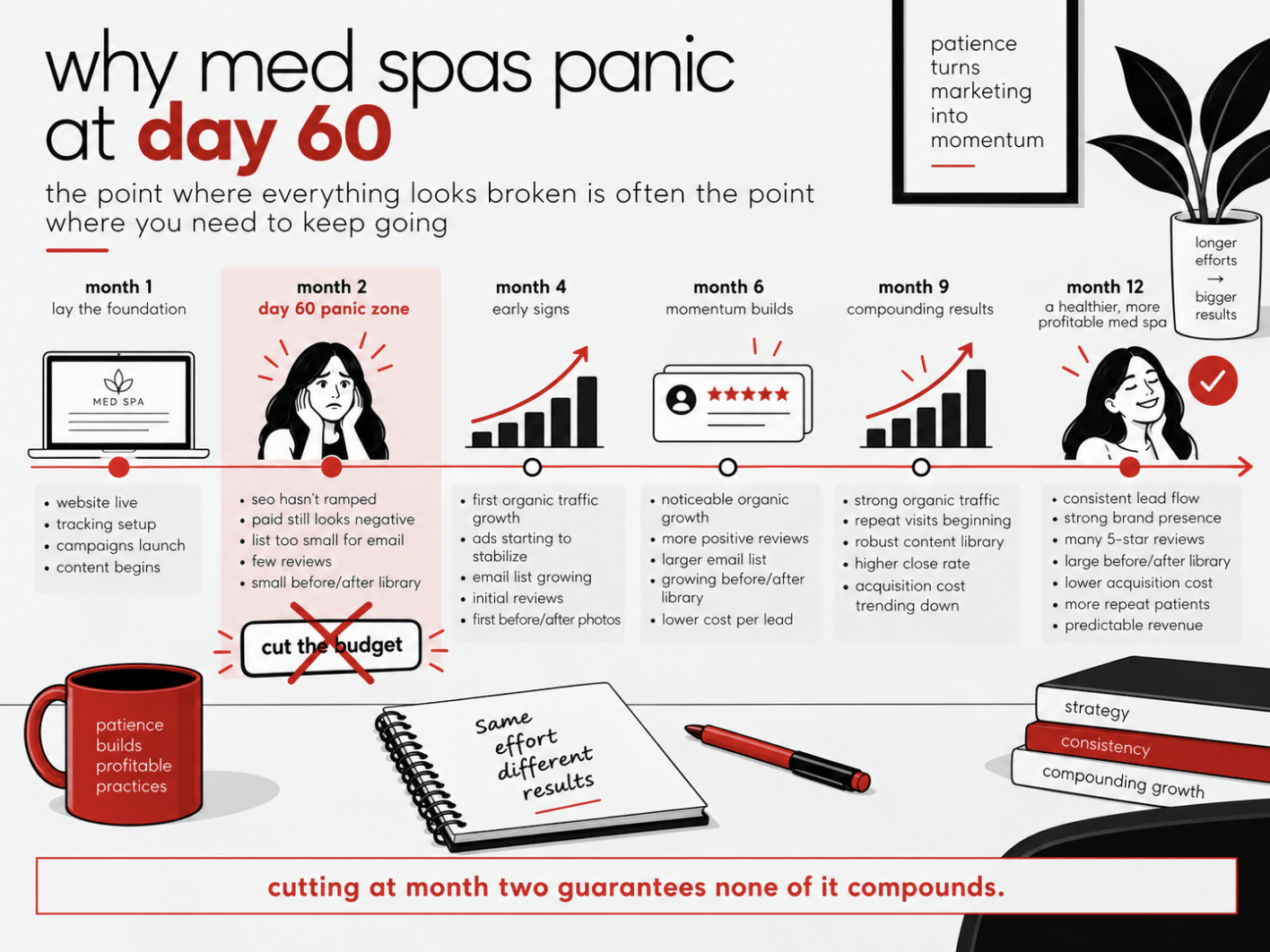
Every one of those resolves with time and none of them resolves in sixty days. The owner who didn’t capitalize twelve months up front panics at precisely this point and starts cutting — and cutting at month two guarantees that none of it ever works.
Practices that fail at marketing rarely picked the wrong channels. They turned everything off before anything had time to compound.
What “committed” means in practice: the twelve months are capitalized before you open, and mid-year changes are reallocations between channels, never reductions to the total. If Meta is underperforming, that money moves to search. It does not go back in the operating account.
Splitting the budget
Divide it into fixed and variable. Fixed — SEO, content, the website — is a monthly retainer that runs regardless, because it’s building an asset. Variable — paid media — should flex with capacity.
And capacity is the constraint nobody writes about: injector chair hours cap how much demand you can profitably buy. If your one injector is at 80% utilization, more leads don’t produce more revenue, they produce longer waits and worse show rates. Scale the paid budget to open appointment slots, not to ambition.
Before-and-afters are make-or-break
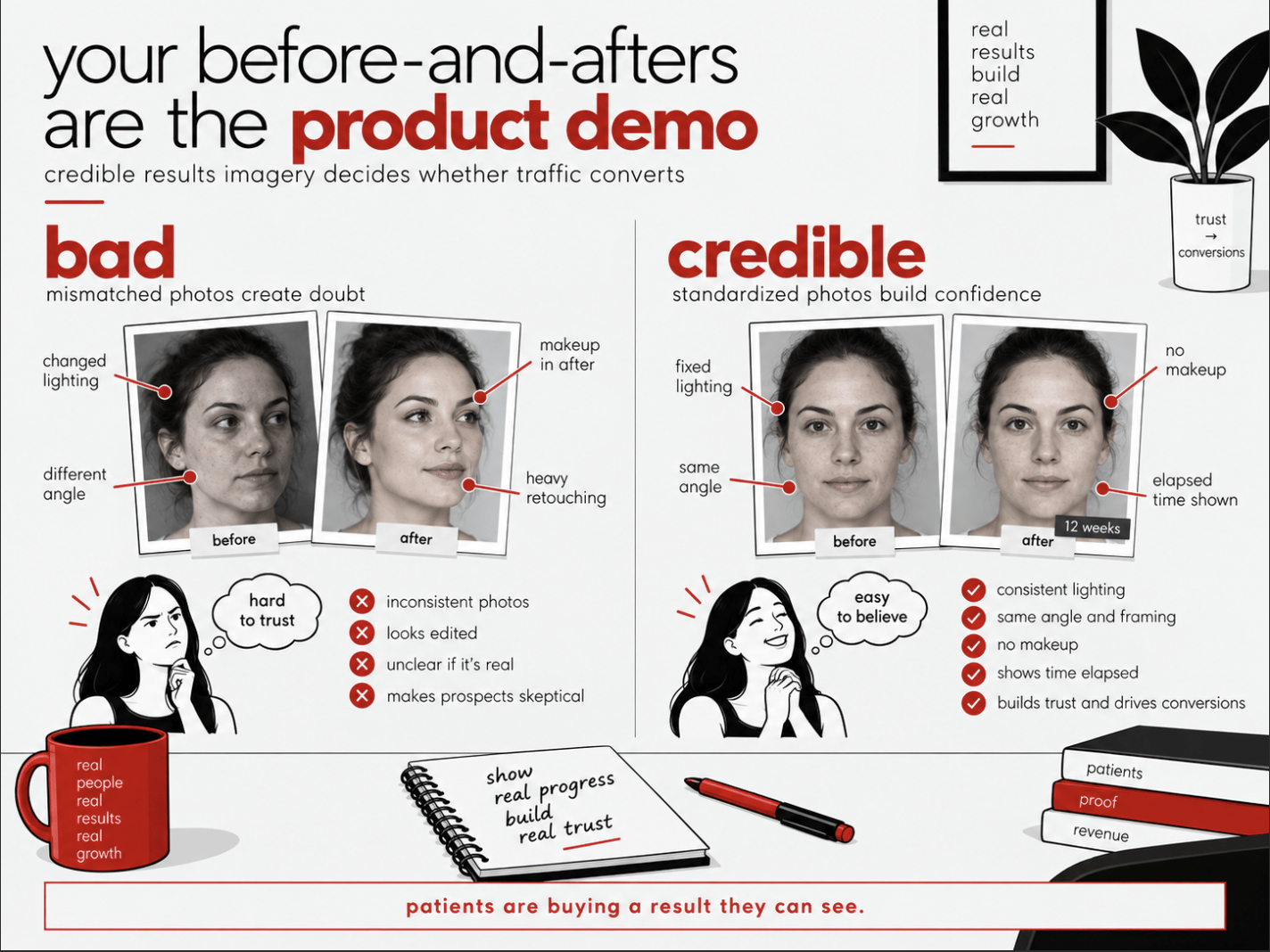
Patients are not buying a treatment. They’re buying a result they can see on someone who looks like them.
That makes your before-and-after photography the product demo — and the single asset that most determines whether traffic from any channel converts. You can fix your bidding strategy in an afternoon. Building a credible photo library takes months, which is exactly why practices that have one are hard to catch.
Most med spa galleries actively hurt the practice. The tells are always the same: the lighting changed, the camera moved, the patient is wearing full makeup in the after and none in the before, the retouching is heavy enough to read as fake. A prospective patient can’t articulate what’s wrong, but they don’t believe it, and disbelief at the gallery kills the click you already paid for.
What a credible set looks like: fixed lighting and a fixed camera position, standardized angles for each treatment type, a neutral background, no makeup in either frame, the elapsed time since treatment stated, and the same patient obviously identifiable across both images.
Getting it done consistently is an operations problem, not a marketing one. It takes a dedicated photo station that doesn’t move, a written protocol per treatment, the discipline to shoot every case rather than the ones that look promising, and a consent step in intake that happens before the first frame.
Then curate honestly. Show realistic mid-range results, not only your three best outliers — patients discount outliers and trust the ordinary case. Cover the range of ages and skin types you actually treat. A gallery of one demographic tells everyone outside it that you don’t treat people like them.
One capture protocol feeds everything: treatment pages, your Instagram grid and Reels, Meta ad creative, Google Business Profile photos, and consult follow-up emails. This is the highest-leverage asset in the practice.
The compliance layer runs alongside it and is not optional: a written photo release separate from treatment consent, HIPAA constraints on identifiable imagery, FTC rules requiring that results shown are typical or disclosed as not, and your state board’s rules on before-and-after advertising. Get the release language reviewed once and use it forever.
And the differentiator almost nobody has adopted: video and multi-angle results. Static photos can be faked and patients know it. A short clip of a result rotating under consistent lighting is far more persuasive and almost no practice in your market is doing it.
Let people book online
If you take one operational instruction from this guide besides the budget, take this one.
The objection is always some version of: “I need to screen patients first,” “my schedule is too complicated,” “I’ll get flooded with no-shows.”
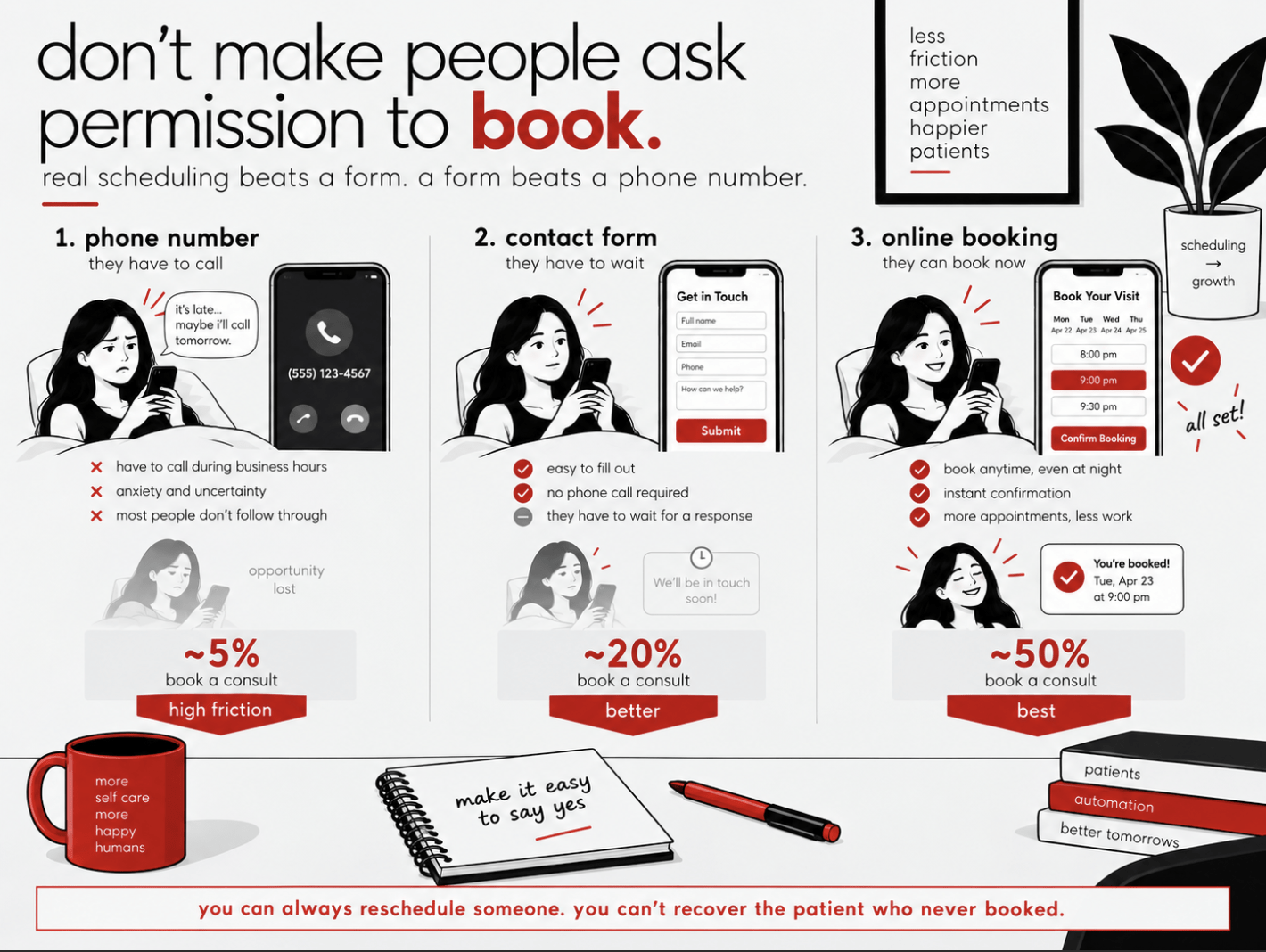
You can always call someone and reschedule. You cannot call someone who never became a patient. Not offering online booking doesn’t screen out bad patients — it screens out all patients who weren’t willing to fill out a contact form and wait.
Think about who you’re losing. The woman comparing two practices at 9pm, one of whom lets her book right now. The person who clicked your ad — the one you paid $12 for — and hit a contact form. The referral who meant to call during business hours and forgot by Thursday. None of them tell you they left.
Ranked by booked-consult rate: real scheduling beats a form, and a form beats a phone number. The gap between real scheduling and a form is not small.
The concerns behind the objection are legitimate and each has a fix:
- Screening: offer consult-only slots online. Treatments still get booked by your staff after the consult.
- No-shows: require a small deposit that credits toward treatment. This filters out the unserious without filtering out the busy.
- Complexity: put treatment-specific intake questions in the booking flow so the appointment arrives pre-qualified.
- Forgetting: automated confirmation plus reminders at 48 and 2 hours.
Then put the booking link everywhere it could possibly be needed: every treatment page, your Google Business Profile, your Instagram bio, every ad landing page, and your email footer.
The rest of your website
Architecture that ranks and converts: one page per treatment, one page per location, plus financing and membership pages. Treatment pages are what rank for the searches with actual purchase intent, and a single “Services” page listing everything will rank for none of them.
Answer the pre-consult questions on the page. Price signals — even a starting-at range — plus candidacy, downtime, and what the appointment actually feels like. Practices hide pricing to force a phone call; the effect is that price-sensitive patients leave and price-insensitive ones do too, because the omission reads as evasive.
Speed and mobile are table stakes. The majority of this traffic is on a phone, often at night. A slow page loses patients before the content matters.
Build tracking in from the start — call tracking, form attribution, and analytics configured on day one. Retrofitting attribution six months in means six months of spend you can never evaluate.
Local SEO and Google Business Profile
Local search is where med spa SEO pays off fastest. For a single-location practice it’s the highest-intent and lowest-cost channel you have. Someone searching “med spa near me” or “botox [your city]” is further down the funnel than anyone you’ll reach on Meta.
Google Business Profile does most of the work: correct primary category, every service listed individually, current photos including results imagery, an actively-managed Q&A section, and regular posts. Most practices set it up once and abandon it, which is why an actively-managed profile still outperforms in most markets.
The map pack ranks on three things: relevance, proximity, and prominence. You can’t move your building, and relevance is largely a matter of getting the categories and services right. Prominence is the one you can actually build — and it’s driven by reviews, brand searches, citations, and links. Remember this when you get to the compounding section, because prominence is where your social following quietly turns into search rankings.
Reviews are both a ranking factor and a conversion factor. Volume matters, recency matters more than most people think, and responding matters — carefully, which the compliance section covers.
Med spa SEO: organic search and content
SEO for med spa websites splits into two efforts — the local signals covered above, and the content and treatment pages covered here. Both matter, and they rank for different things.
Target the keywords that convert, which are rarely the highest-volume ones: treatment plus city, “cost of [treatment],” “[treatment A] vs [treatment B],” and “am I a candidate for [treatment].” That last category is where patients are closest to booking and where competition is thinnest.
Know which page type each keyword belongs to. Commercial searches — the ones with purchase intent — belong on treatment pages. Educational and comparison searches belong in blog content that links to those treatment pages. Practices routinely target commercial keywords with blog posts and then wonder why the traffic doesn’t convert.
E-E-A-T is not optional in medical aesthetics. Content should be attributed to your medical director or injector by name and credential, with a real bio. Google applies a higher bar to anything touching health, and an unattributed article on a med spa site is fighting uphill.
The honest timeline is four to eight months to meaningful organic volume. That’s not a reason to skip it — it’s the reason to start it in month one and to fund it for a year, because the practice that starts SEO when paid gets expensive is already two quarters behind.
AI answers matter now. A meaningful share of these queries return an AI Overview before any blue link. Getting cited there rewards the same things: clear structure, direct answers to specific questions, real attribution, and information that isn’t available on every other page.
Paid search (Google Ads)
Use paid search when you need volume now — a new location, a new device you have to fill, or a metro where organic will take a year.
Structure by intent. Branded and non-branded belong in separate campaigns with separate budgets. Branded search converts at several times the rate and costs a fraction; blending them produces a flattering average that hides how non-branded is really doing.
Send clicks to a treatment-specific landing page, never the homepage. Someone searching for Morpheus8 should land on a page about Morpheus8 with a booking widget on it.
Expect to be underwater on the first visit. See the economics section — this is where that argument bites hardest.
Google’s healthcare and personalized-advertising policies restrict what you can target and how you can remarket for health-related services. Get familiar before you build audiences you’re not allowed to use.
Meta advertising (Facebook and Instagram)
Meta does something search cannot: it creates demand for treatments the patient wasn’t looking for. Nobody searches for a treatment they’ve never heard of. That makes Meta the right channel for newer devices and body treatments, and the wrong channel to rely on for the patient who already knows what they want and is comparison shopping — that patient is on Google.
Lead ads versus landing pages is the decision that most determines lead quality. Lead ads are cheaper per lead and convert worse, because the friction that makes them cheap is the same friction that was qualifying people. Landing pages cost more per lead and produce leads that show up. If your team is measured on cost per lead, you’ll pick wrong.
Creative that works in aesthetics is your injector on camera talking like a person, real results from your own gallery, and genuine education about what a treatment does. Stock photography of a woman in a towel fails completely — patients have seen it a thousand times and it signals that you have nothing real to show.
Be careful with offers. A strong discount produces volume and a cohort that never rebooks. Consult-based offers and reasonable first-treatment pricing produce fewer leads and better patients.
Special Ad Category applies to some health-related advertising and removes targeting options you might be counting on. Build your audience strategy knowing that up front.
Speed to lead is the whole game. A Meta lead contacted in five minutes books at a dramatically different rate than one contacted the next morning. This is usually the cheapest fix available to a practice with a “lead quality problem.”
HIPAA on Meta specifically is where med spas create real exposure — the Meta pixel firing on treatment pages, the Conversions API, and custom audiences built from patient lists. It’s involved enough that we’ve written it up separately: running HIPAA-compliant Facebook ads.
Med spa email marketing and SMS
This is the cheapest revenue in the practice and the most commonly ignored, because nobody bills you for skipping it.
Rebooking sequences by treatment interval are the core of it. Toxin patients get contacted at the 3-month mark. Filler patients at 9 to 12 months. Package patients between sessions. This is the machinery that makes the paid-media argument work — without it, every patient you acquire at a loss stays a loss.
Memberships and pre-paid packages convert best when offered to patients who’ve already had two or three treatments, not to first-timers.
Reactivation of patients who haven’t been in for a year is usually the single highest-ROI campaign a med spa can run, and most have never run one.
TCPA governs SMS, and it’s strict: express written consent before texting, functional opt-out handling, and quiet-hours restrictions. Consent for appointment reminders is not consent for promotional messaging. Collect them separately.
Med spa social media marketing and reputation
Be realistic about the role. Instagram and TikTok are proof and trust, not primary acquisition for most practices. Very few patients see a Reel and book on the spot. A great many check your Instagram after finding you somewhere else — and what they find there decides whether they book.
That reframes what to post. Content that earns saves, shares, and DMs beats content that fills the grid. Results, education, and the injector’s actual face outperform reposted quotes and stock imagery.
Practitioner-led accounts outperform brand-led accounts, consistently. Patients follow people. This is uncomfortable if your injector might leave, but the answer is to feature multiple practitioners, not to be faceless.
Responding to a negative review requires care. You cannot confirm that someone was a patient. Acknowledging their visit at all is a HIPAA disclosure. The safe response is generic, invites the conversation offline, and never references treatment or attendance.
Your channels compound — stop budgeting them as separate line items
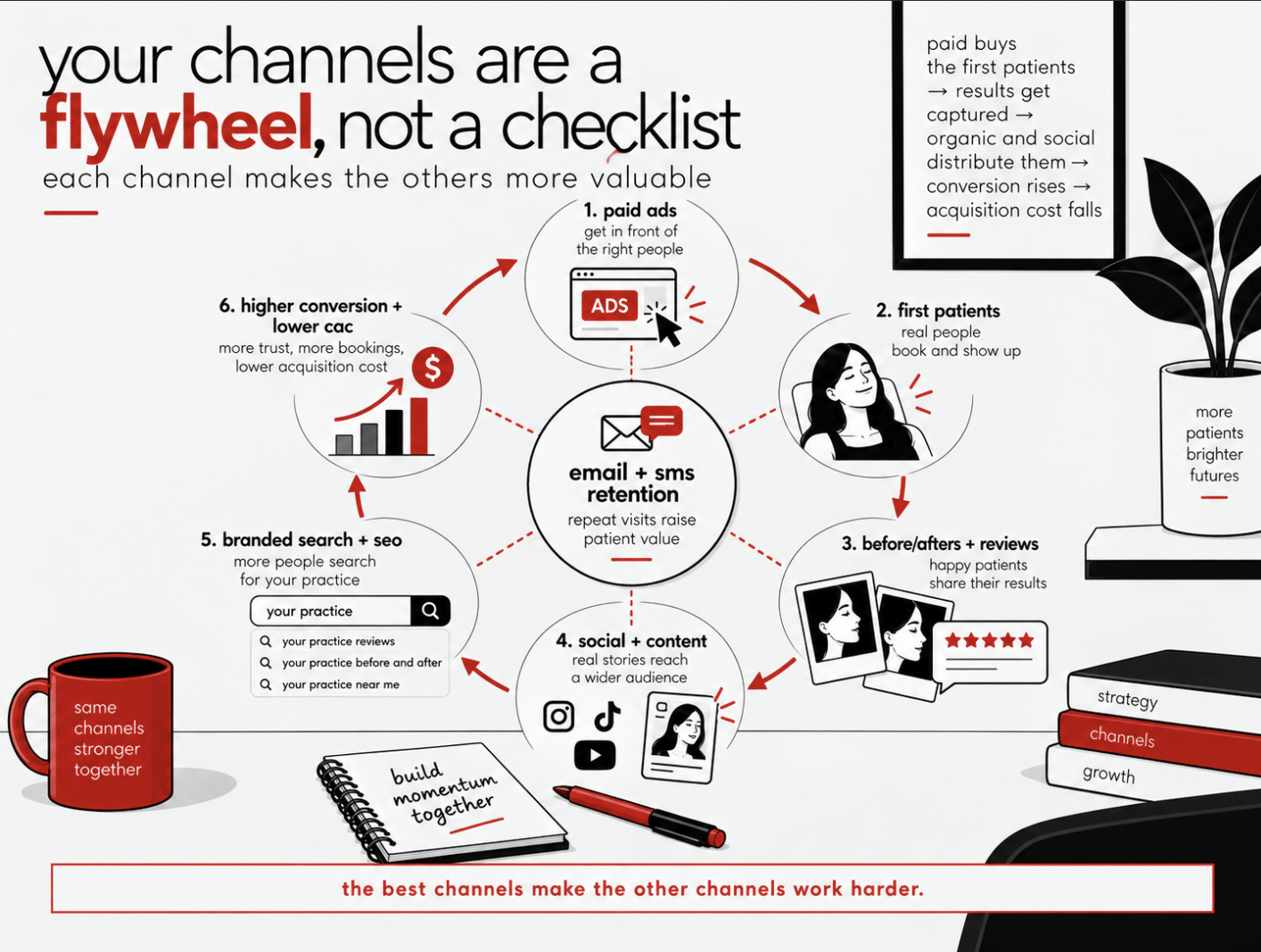
Every other guide on this topic presents these channels as a checklist of independent line items. That framing is why most med spa marketing underperforms, because the return on any one channel is a function of how the others are doing.
Social makes search convert. A visitor arrives from Google, checks your Instagram, and finds an active account with real results and a recognizable face — she books at a materially higher rate than the visitor who finds an abandoned grid. Pushing search traffic to social is a conversion play, not a vanity play.
Social makes search rank. People who discover you on TikTok or Instagram then go search your name. That branded search volume and direct traffic is exactly what Google reads as prominence — the one map-pack ranking factor you can actually build. Your TikTok is a local SEO input, whether or not anyone books from it directly.
Email and SMS grow the social following. Your patient database is the warmest audience you’ll ever have for a follow request, and a larger engaged following feeds both effects above.
Retention funds acquisition. The rebooking machinery makes the first-visit loss survivable, which is what lets you bid at a level your competitors optimizing to day-one ROAS cannot match.
Reviews sit in the middle of everything. Paid and organic both produce patients, patients produce reviews, and reviews lift map-pack rank and conversion rate on every channel simultaneously.
Before-and-afters are the shared asset. One capture protocol supplies treatment pages, ad creative, the grid, GBP, and follow-up email — which is why it came first in this guide.
The loop, stated plainly: paid buys the first patients → results and reviews get captured → organic and social distribute them → rankings and conversion rates rise → acquisition cost falls → the same budget buys more.
Two consequences worth internalizing.
For measurement: last-click attribution systematically undercounts assisting channels. Any channel evaluated in isolation will look worse than it is, and the ones that look worst are usually the ones doing the most assisting.
For budgeting: kill the weakest-looking channel and you frequently degrade two others. Starve deliberately and in sequence, never reactively.
The practical version — specific cross-channel moves worth building in:
- Social CTAs on every treatment page and in the booking confirmation
- A follow request in the post-treatment SMS
- Retargeting site visitors with results content rather than offers
- GBP posts drawn from the same content calendar as social
- Review requests timed to the appointment, not sent in monthly batches
Compliance: the rules that apply to med spa marketing
No other guide ranking for this topic covers this, and nearly every asset you produce is governed by it.
HIPAA reaches further into marketing than most owners expect. It covers patient photos and the releases behind them, testimonials, review responses that confirm someone was a patient, and — the one that catches practices — tracking pixels on pages that reveal treatment interest. A pixel firing on your labiaplasty page transmits something close to a diagnosis to a third party. This is the most common unexamined exposure in med spa marketing: running HIPAA-compliant Facebook ads.
State medical board rules vary and bind. Many states regulate whether you can call yourself a “medical spa,” require disclosure of the supervising physician, and impose specific requirements on before-and-after advertising and disclaimers. Check yours specifically — this is not an area with a national answer.
FTC rules govern testimonials and endorsements: results shown must be typical or disclosed as atypical, and any influencer or staff endorsement requires clear disclosure of the relationship.
Prescription treatments carry restrictions on how you may advertise them by brand name. Manufacturer co-op programs usually come with their own usage rules on top.
Before any campaign goes live, confirm: photo releases signed and on file, disclaimers on results imagery, pixel configuration reviewed for treatment-revealing pages, SMS consent language current, and supervising-physician disclosure present where required.
Measuring what’s working
Set up the plumbing: call tracking with dynamic number insertion, form attribution that survives the handoff, and — the one that matters most — offline conversion import from your practice management system back into Google and Meta. Without it, the platforms optimize toward leads. With it, they optimize toward patients who actually booked and paid. Most med spas never do this, and it’s the difference between advertising and guessing.
Review three numbers monthly: cost per booked consult, consult show rate, and revenue per new patient at 90 days. Not impressions, not clicks, not cost per lead.
Understand what attribution is doing to you. Last-click overcredits branded search, which is mostly harvesting demand other channels created, and undercredits everything that created it. Read your reports knowing this rather than treating them as truth.
Know when to kill a channel versus when it hasn’t had enough runway. Paid search should show a cost per booked consult within 60 days. Paid social needs 90 to get through learning and creative iteration. SEO needs six months minimum. Judging any of them on a shorter window tells you nothing — it just gives you a reason to cut, which brings you back to the budget section.
A twelve-month med spa marketing plan
Sequence matters as much as channel selection. Here’s the order the strategies above should come online.
Months 1–2 — foundation. Website and treatment pages, online booking, tracking and analytics, Google Business Profile, review generation, photo capture protocol, and a reactivation campaign to any existing database. Nothing here is glamorous and all of it multiplies everything that follows.
Months 3–6 — buy volume while the asset builds. Paid search and paid social carry appointment volume while SEO and content compound quietly. Expect paid to look unprofitable during this window. Expect SEO to look like nothing is happening. Both are normal.
Months 6–12 — compounding. Organic traffic becomes material, your review base starts moving map-pack position, your before-and-after library is deep enough to make ad creative easy, and your first paid cohorts return for visit two — which is the month the paid numbers finally look like what you were promised. Now retention programs and a second service line or location come into play.
Treat those as ranges, not promises. Market competitiveness, starting position, and how well the foundation was built all move the timeline.
When to hire a med spa marketing agency versus keeping it in-house
Realistically in-house: organic social, review generation, email and SMS to your own list, and photo capture. These need proximity to the practice and daily attention more than they need specialist skill.
Realistically not: technical SEO, paid media management, and a conversion-focused website build. These need specialist skill and enough account volume to know what normal looks like.
What to ask any agency you’re considering:
- Will you report cost per booked consult, or only cost per lead? (If only cost per lead, you’ll never know if it’s working.)
- Who actually runs my account day to day?
- What healthcare and aesthetics experience do you have, specifically?
- How do you handle HIPAA in tracking and audience building? (Most agencies have not thought about this. It’s a fast filter.)
- What’s the reporting cadence and will I have direct access to the ad accounts? (Insist on owning your accounts.)
Frequently asked questions
How much should a med spa spend on marketing per month? The average is around 4.2%, and most practices should be at 5–8%. Decide the number before you open and fund it for twelve months.
How long should I commit to a marketing budget before judging it? A full year. At sixty days every channel looks like a failure simultaneously — SEO hasn’t ramped, paid cohorts haven’t returned, and your database is too small for email to work. That’s the moment most practices cut, and cutting there guarantees none of it works.
How long does SEO take for a med spa? Four to eight months for meaningful organic volume, longer in competitive metros. Local and Google Business Profile results come faster than content-driven rankings.
Are Facebook ads or Google Ads better for a med spa? They do different jobs. Google captures patients already searching for a treatment. Meta creates demand for treatments patients weren’t considering. New devices and body treatments lean Meta; injectables and established treatments lean Google.
What is a good cost per lead for a med spa? It’s the wrong question. A cheap lead that doesn’t show is worse than an expensive one that books. Track cost per booked consult and cost per treated patient instead.
Should my med spa ads be profitable right away? On most paid channels, no — and expecting it will cause you to shut down campaigns that were working. With Google Ads for injectables you’re usually negative on the first visit and profitable by month twelve, provided you have a rebooking system.
Do I really need online booking? Yes. You can always call and reschedule someone; you can’t call the patient who never booked. The concerns about screening and no-shows are solved with consult-only slots and deposits, not by removing booking.
How many before-and-after photos do I need before advertising? Enough per treatment to show a realistic range rather than only your best case — and shot to a consistent protocol. A small consistent set outperforms a large inconsistent one.
Can I use patient before-and-after photos in ads? With a written photo release separate from treatment consent, subject to FTC rules on typical results and your state board’s advertising rules. Get the language reviewed once.
What’s the most profitable med spa service to advertise? Judge by twelve-month value, not first-visit revenue. Treatments with natural repeat intervals — neurotoxin especially — usually justify the highest acquisition cost even when the first appointment is small.
Where this leaves you
Get the before-and-afters and the booking flow right before you buy traffic, because they determine whether any of it converts. Judge paid channels on what a patient is worth in twelve months, not on what they spent on day one — that’s what lets you compete for the impressions worth having. And run the channels as a loop rather than a checklist, because the compounding between them is most of the return.
The channel was never the decision. Acquisition cost measured against lifetime value is.

