

SEO for Hair Transplant Clinics
If you’re trying to figure out SEO for your hair transplant clinic and you’re looking for an article by someone that’s actually done extensive work in the space, you found the article that you were looking for.
We’ve worked with hair transplant clinics in the United States and Europe.
We’ve done SEO and we’ve done Google Ads for your industry.
In fact, we were nominated for a Search Engine Land Award for the results we’ve driven for Philadelphia Hair Restoration.
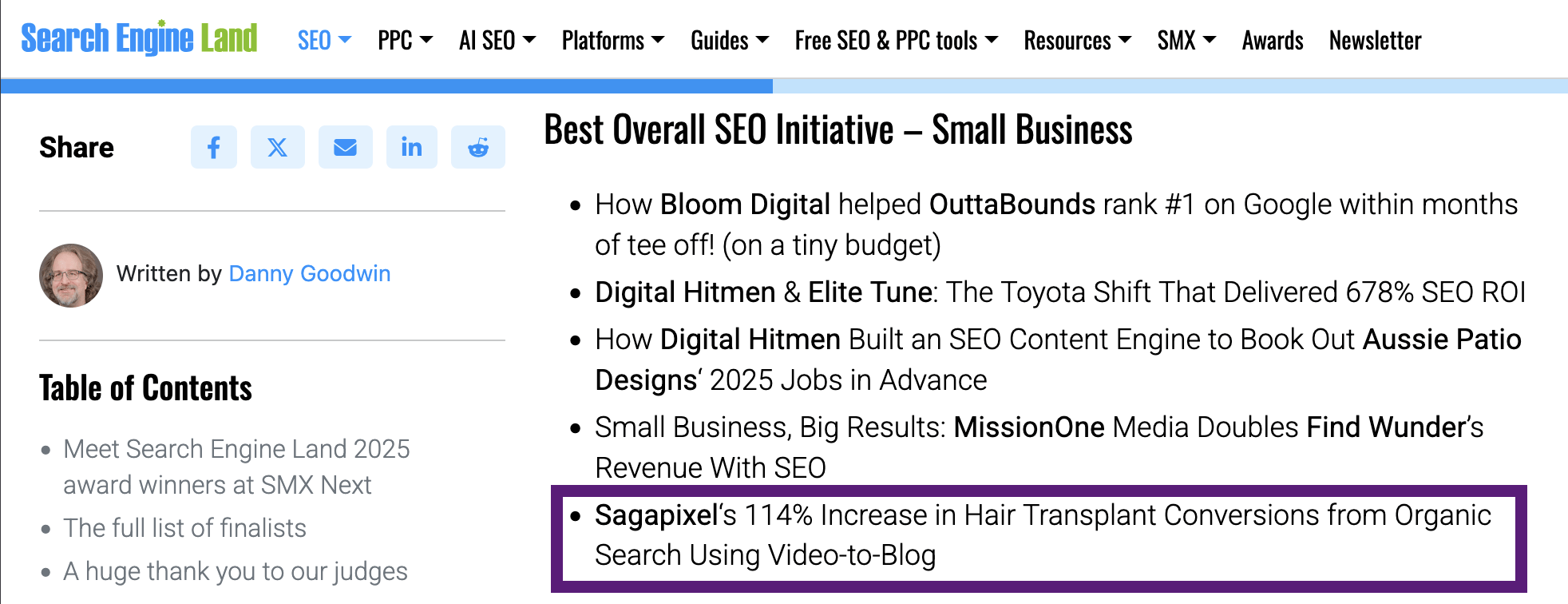
We’ve worked with industry leaders that you probably know, as well as a number of small operators whom you most certainly do not know.
I’m going to share with you in clear terms what you need to do to get your hair transplant clinic’s SEO on track.
We are a healthcare SEO company and we’ve done extensive amounts in aesthetic medicine in general, including plastic surgeons, hair transplant, and medical spas.
The truth is that everything that is applicable to SEO for plastic surgeons is applicable to SEO for hair restoration and hair transplant.
Before we get into the specifics, it’s essential to establish why organic traffic is beneficial for a hair transplant clinic and how it can generate consults.
How Hair Restoration Clinics Benefit from SEO
It’s vital for hair restoration clinics to not only have a website but to have one that can be found by potential patients in search results.
When it comes to cosmetic procedures, it’s common for potential clients to conduct Google searches before they commit.
They’ll search questions, procedures, and specific clinics to better understand if the procedure is right for them.
If your website isn’t showing up for these queries, you have no chance of turning that user into a client.
Instead, they’ll find answers from other clinics and go there for their hair restoration.
SEO effectively has four parts to it.
Part One: Technical SEO
Technical SEO ensures Google can optimally crawl, index, and understand the structure of your website.
It largely entails making sure your website is structured in a way that optimally passes PageRank over to your procedure pages as well as facilitating Google’s ability to crawl and index your content.
One of the very first things you’re going to do is set up your Google Search Console.
This is a place where you’re going to be able to submit your sitemap to Google and see what pages are getting indexed and, more importantly, what pages are not.
It’s common for new websites to accidentally check a box in the CMS that says, “discourage Google from indexing this site.”

If this box is checked, your whole website is marked as “noindexed,” and Google won’t add your pages to its index.
You must ensure that your website and each individual page are set to “index” so they start showing up in searches.
Technical SEO also involves addressing slow-down issues that could arise as you make changes to your website.
Site Architecture and Internal Linking
Next, we have to make sure that we’ve established some sort of site architecture and internal linking for all of our pages.
Internal links are links on your internal pages that point to other internal pages, connecting everything.
During a crawl, it’s internal links that the Googlebot follows to discover all the pages on your website.
If you have a page without internal links, Google won’t know it’s there; these are what we call “orphan pages.”
Internal linking also helps Google understand what each page is about based on the anchor text, which are the words you use to hyperlink.
For example, if you have a hair transplant page, you should link to it using the anchor text “hair transplant.”
You should also have top navigation and a footer with links to ensure all pages are discoverable.
In the case of Maximum Hair Restoration, we want to rank for all the hair transplant plus location type queries like Fort Worth, Dallas, and Long Island.
A key part of technical SEO is to make sure you have clusters of pages linking to one another.
It would benefit these location pages to have a section that says, “We serve all of these areas,” linking to each one individually.
All of them should also be linking up a layer to a parent locations page, often through breadcrumbs.
Getting this right will increase the amount of PageRank flowing to each individual page, helping all of them to rank better.
Part Two: Maximizing Content Relevance
The second part of SEO is maximizing the relevance of your content to the searches people are performing.
Location Pages and Local Intent
When it comes to cosmetic procedures, they usually have local intent.
This means that someone will likely not travel from Florida to a hair transplant clinic in California.
More times than not, they’ll go somewhere nearby.
You’re going to need pages on your website targeting all the Service Plus Location type queries, such as “hair transplants Los Angeles” or “NeoGraft Los Angeles.”
Getting one general NeoGraft page ranking across all of North America is almost impossible.
In this space, it’s generally very easy to get these pages ranking in small markets, so you should see results quickly.
Blogging and the Buyer’s Journey
The second half of maximizing relevance is blogging the right way.
You want to answer all of the questions that people have about the procedures you perform.
If you are not discerning in what topics you select, you can find yourself wasting a lot of time.
You should only target keywords on the buyer’s journey at the bottom of the funnel.
Targeting a query like “How long do hair transplants typically take?” is very clearly on your buyer’s journey.
“Did Joe Rogan get a hair transplant?” might be an opportunity to fight misconceptions, but it is less likely to get you in front of your target customer than high-intent searches.
By showing up for these searches, you’ll grow trust and authority, making patients feel more comfortable contacting you.
Part Three: Maximizing Trust and E-E-A-T
The third part of SEO is maximizing your trust through quality and authority.
Quality and the YMYL Niche
You are in what Google refers to as a “Your Money or Your Life” (YMYL) niche.
This means your website goes through an algorithm to determine if you’re providing sound medical information.
Google is very iffy about certain topics like PRP; you’re not even allowed to run Google Ads for it.
If you have content that Google deems objectionable, it could affect the entire website.
Google’s AIs are capable of determining the level of expertise of the author, so I don’t recommend autogenerating content from ChatGPT.
Even if that content gets in front of people, it’s unlikely to impress someone enough to make them fly across the country to see you.
Leveraging Doctor Experience with “Video to Blog”
To truly stand out, you need to lean into the first “E” in Google’s E-E-A-T framework: Experience.
Google prioritizes content that comes from a place of firsthand medical experience, which is why we utilize a “video to blog” approach.
We put our doctors on camera for focused, one-hour sessions.
We use this footage to generate both high-quality YouTube videos and generate articles from the transcript that capture the doctor’s actual perspectives and surgical experience.
This ensures the content isn’t just generic medical advice written by a marketer; it’s an authoritative resource that carries the doctor’s unique voice and expertise.
By having a certified physician directly involved in the creation process, we satisfy Google’s requirement for expert-led content while building immediate trust with the reader.
Earning Backlinks and Off-Page SEO
The second half of maximizing trust of your website is earning backlinks, which is the process of acquiring links from other websites.
These links signal to Google that your pages are important and authoritative.
Spammy links from low-quality websites won’t help and could even hurt your prospects.
As far as active link building, you can use guest posts, where you write a blog post for another website that links back to yours.
You should not engage in guest post link building at scale, as it is against guidelines, but it can be a reliable start.
Another method is broken link building, which involves reaching out to websites that have broken links to pages that no longer exist.
You can write a similar piece of content and pitch it to the webmaster as a replacement for their dead link.
Passive Link Acquisition
Over time, you should develop a passive link acquisition approach.
Tools and calculators often earn links without any outreach.
Doing something newsworthy can passively earn links, although you usually need a publicist.
Definitions and reference content, like “What is NeoGraft?”, also work well.
Statistics and numbers commonly earn backlinks naturally.
If someone is writing an article and wants to mention how many hair transplants are done in Turkey each year, they will find your data and cite you as the source.
Part Four: Your Google Business Profile
The fourth part of SEO is your Google Business Profile (GBP).

When someone searches “hair transplant Philadelphia,” the map results appear right at the top.
Internet users often go directly to the map results without scrolling down to the organic pages.
You need to claim your profile, set it up with great photography, and have a review acquisition strategy.
You want trusted reviews from Gmail accounts that use the keywords you would like to target.
Backlinks are also a part of the map algorithm, which is why your overall authority matters.
Part Five: Tracking Your SEO Results
Once you put these practices in place, you need to determine if your efforts are working.
We primarily focus on conversions, such as calls or contact form submissions.
However, clicks and impressions are the leading KPIs to generate these conversions.

Impressions show how many people saw your page, even if they didn’t click.
Clicks tell us how many people actually visited your site.
We also use tools like Ahrefs to track where your pages rank for specific keywords and to see if positions have risen or fallen:

Google Search Console may show opportunities to target keywords you missed, like a specific technique like NeoGraft instead of just “hair transplant.”
Knowing this allows you to better tailor your content to what prospective patients are actually searching for.
