

You’re spending $4,000 a month on Meta. The leads are cheap — $11, $14, sometimes $8 on a good week. Ads Manager looks fantastic. Then your front desk tells you that half the numbers go straight to voicemail and stay there, and the people who do pick up are asking whether you take Medicaid for a procedure that isn’t covered by anything.
So you conclude that low quality leads are just what Facebook produces, and you go back to Google.
I’ve audited a lot of accounts in exactly that state, and the diagnosis is almost never what the account owner expects. It comes down to one of three things: the creative is saying the wrong thing to the wrong people — or the wrong thing to the right people; the advertiser hasn’t given anyone a reason to trust them; or the leads are actually fine and the expectations aren’t. The platform settings everyone blames — Audience Network, form types, optimization events — do matter. But they’re housekeeping. You clean them up in an afternoon, and if the leads are still bad afterward, the problem was never the platform.
Here’s how to work through it in order.
What “low quality leads” actually means
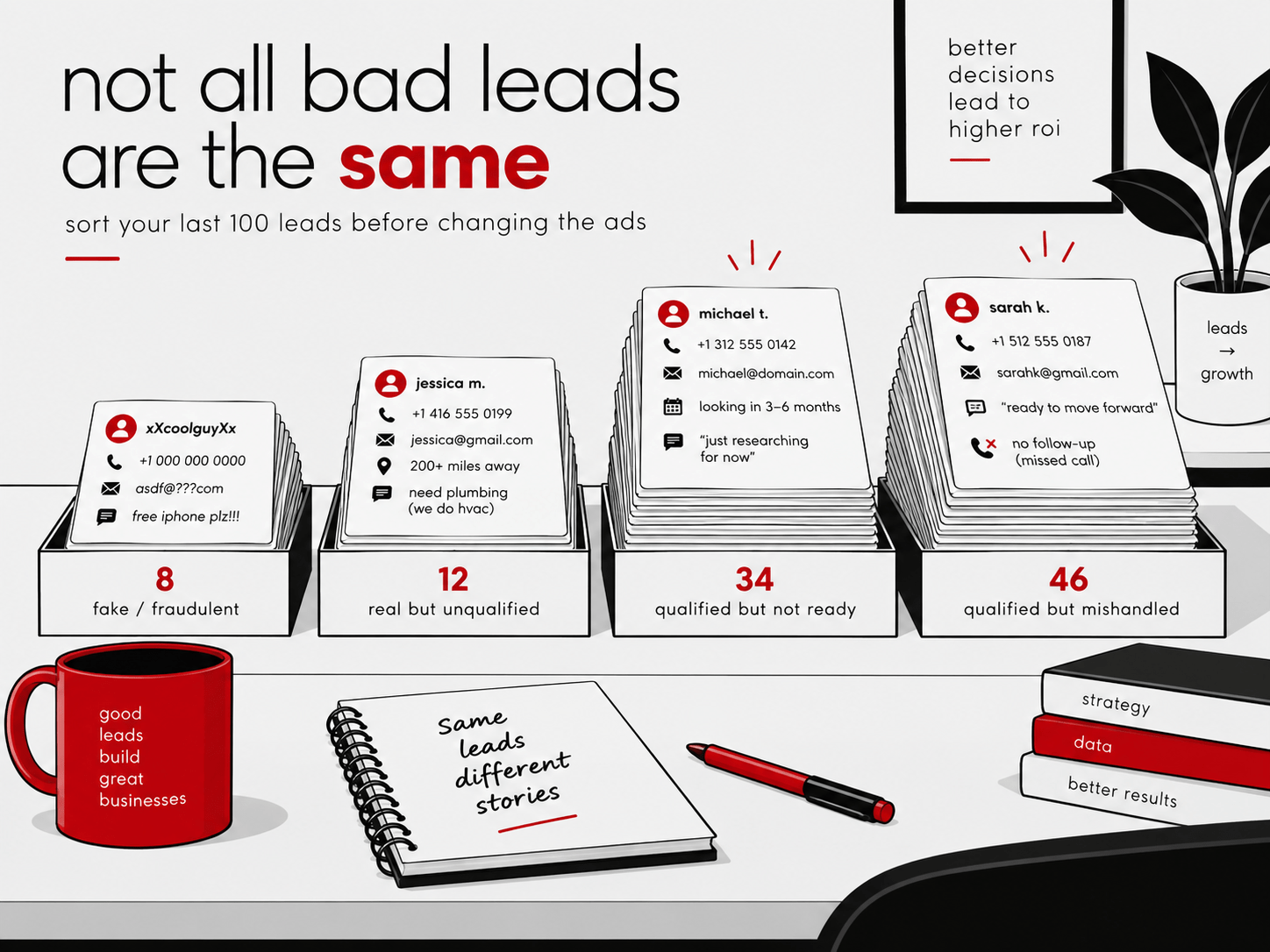
Before you can fix this you have to be precise about what you’re looking at, because “bad leads” is four different problems wearing the same coat.
Fake or fraudulent leads. The contact information is garbage. Numbers disconnect, emails bounce, names are keyboard mash. Nobody was ever on the other end.
Real but unqualified leads. A real human filled out your form and will never become a patient. They’re 400 miles away, they want a procedure you don’t perform, or they were never going to spend $7,000 on anything.
Real, qualified, but not ready to trust you with the decision. This is the one almost everyone miscategorizes. They meant it when they filled out the form — your ad was compelling enough to get a genuine candidate to raise their hand. But filling out a form is a low-risk thing to do, and choosing a surgeon isn’t. They’re not a bad lead. They’re an early one. Nothing your front desk says in the next twenty minutes is going to close that gap, and calling three times and marking them dead throws away someone who might book in four months.
Real, qualified, but mishandled. This person was ready, or close to it. Somebody called them nine hours later, left one voicemail, and marked them dead.
Those last two are where most of the volume sits in the accounts I look at, and neither one costs a dollar in ad spend to fix.
Before you change a single setting, pull your last 100 leads and sort them into those four piles. The mix tells you where to look. Heavy on pile one, you have a placement or fraud problem. Heavy on pile two, you have a message or targeting problem. Heavy on piles three and four, your ads are working and the failure is happening after the lead arrives.
First, rule out the mechanical problems
This is the section that makes up the entirety of most articles on this topic. Do all of it, don’t expect much from it, and move on to the parts that matter.
Audience Network and automatic placements. Meta’s Advantage+ placements turn on Audience Network by default, which serves your ad inside third-party apps and games. It reliably produces the worst leads in any account — a meaningful share of them are misclicks from someone trying to close an ad in a mobile game. Break your reporting down by placement and compare cost per lead against how many of those leads actually booked. If Audience Network is cheap and converts at nothing, switch to manual placements and turn it off. The exception is genuinely low-ticket, high-volume offers where you can tolerate a low close rate; for a practice selling four-figure procedures, you can’t.
Optimizing for the wrong event. If you optimize for “Leads,” Meta will get very good at finding people who fill out forms. Filling out forms is not the same behavior as booking and showing up. Where volume allows, optimize for a deeper event — a booked consult rather than a form fill. The honest caveat nobody includes: Meta needs a meaningful number of those events per week to optimize against them, and most single-location practices don’t generate enough booked consults to support it. If that’s you, optimize for the form fill and do your qualifying in the creative instead. Don’t let anyone sell you on a deep-event strategy your volume can’t feed.
A frictionless instant form. Instant forms prefill name, email, and phone from the Facebook profile, which means a lead can happen almost by accident. Switch the form type from “More Volume” to “Higher Intent” so there’s a review step, require manual entry on the phone number, and add two to four qualifying questions. Not eight — two to four. Ask what they’re interested in, roughly when, and where they’re located.
Bots and click fraud. Real, but rarer than the internet suggests. The pattern is recognizable: submissions arriving faster than humans could plausibly produce them, malformed contact data, and odd geographic clustering. Tighten placements and add form friction, and it mostly resolves. Don’t reach for this explanation first — in most accounts it’s a way of avoiding a targeting conversation.
One compliance note for medical practices specifically, because the standard advice on this topic ignores it: sending conversion data back to Meta is genuinely useful, but a practice is a covered entity and Meta is not a business associate. Information tying an identifiable person to a condition or treatment shouldn’t be going back to an ad platform, and there has been real enforcement activity on exactly this. Talk to your counsel about what your feedback loop is allowed to contain before you build one. This is a case where the generic marketing advice can get a practice in trouble.
Cleaned all of that up and the leads are still bad? Good — now we’re at the actual causes.
Cause 1: Your creative is saying the wrong thing to the wrong people
This is the most common real cause, and it’s worth splitting into a grid, because the two failure modes look identical in the reporting and need completely different repairs.
Right message, wrong audience. Your copy is good and it’s landing in front of people who can’t buy — out of your service area, out of budget, wrong life stage. This is the version everyone assumes they have, and it’s the easier one to fix.
Wrong message, right audience. This is the expensive one, and it’s far more common. Your targeting is fine. The ad is reaching exactly the people you want. But the ad gives them a reason to raise their hand that has nothing to do with becoming a patient. A discount-led hook, a giveaway, a “free guide,” a curiosity angle about whether you might be a candidate — these all generate volume, and they generate it from people who want the thing in the ad rather than the thing you sell. You didn’t attract the wrong people. You attracted the right people with the wrong promise, and now you’re calling that a lead quality problem.
The fix for the second one is uncomfortable, because it means your cost per lead is about to go up: put the qualifying language in the ad itself. Say the price, or at least the range. Say where you are. Say who this isn’t for. An ad that opens with “rhinoplasty in Bryn Mawr, starting at $9,500” will generate a fraction of the leads that “find out if you’re a candidate” generates, and a much larger share of them will be people who read the number and kept going anyway.
Your creative is your real targeting layer. Every filter you put in the copy does more work than any audience setting in Ads Manager, because it operates on intent rather than demographics.
To figure out which of the two you have, read your own ad the way a stranger scrolling past would, then go listen to what your front desk hears when they call these leads back. If the first thing out of the lead’s mouth is different from what the ad promised, you’ve found it.
Cause 2: They don’t trust you yet
Nobody writes this section, and it explains more bad leads than every platform setting combined.
Think about what actually happened. Someone was scrolling between a photo of their nephew and a video about sourdough, and for about four seconds your face was in the way. They tapped something. Their name and number were already filled in. They tapped again.
That is a near-zero-commitment act by someone with near-zero familiarity with you. Treating it as a signal of purchase intent — and then being disappointed when it doesn’t behave like one — is the mistake. A form fill from a cold feed impression means mild curiosity. It does not mean “I have decided to spend $7,000 with this practice.” When you benchmark those leads against people who typed “plastic surgeon near me” into Google, of course they look terrible. Those people were shopping. Yours were interrupted.
The work, then, is closing the familiarity gap — before the form, after the form, on the phone, and for months afterward.
Put trust signals in the ad
Put the surgeon on camera. Use their name, their credentials, the years in practice, the actual location. Show real outcomes rather than stock photography. Specificity is what separates you from the dozen medspa ads in the same feed, and specificity is what a stranger uses to decide whether you’re real.
Treat the landing page decision as a trust decision
This is where the instant-form-versus-landing-page question actually gets settled, and the entire industry frames it wrong. It’s presented as a friction tradeoff — forms are easier, so they convert better. It’s really about trust. The more the prospect is being asked to commit to, the more they need to see before handing over a phone number. For a $200 treatment, an instant form is fine. For a $9,500 procedure, sending someone straight to a form means asking a stranger for their number before they’ve seen a single before-and-after, a price, a financing option, or a face. Send that traffic to a page that answers those things and you will get fewer leads and more patients.
Warm the audience before you make the ask
A first-touch request converts worse than a third-touch request, every time. Run video content to a cold audience, build a retargeting audience from people who watched a meaningful portion of it, and make your lead ask to that warmed audience. The people who see the offer will have seen you before. This single change does more for lead quality than anything in Ads Manager.
Nurture the ones who aren’t ready yet
This is the fix for that third pile, and it’s the biggest missed opportunity in most practice marketing.
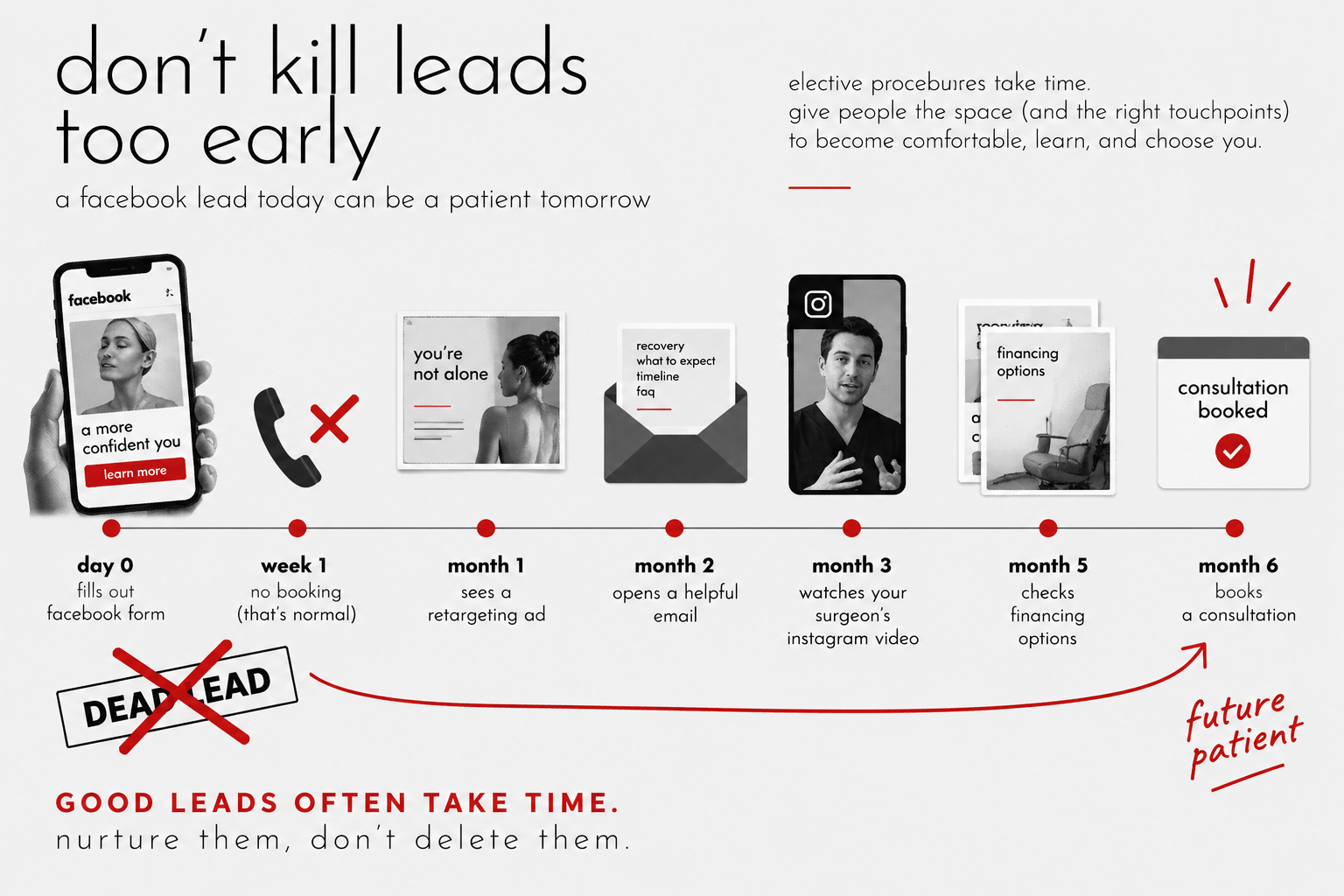
A qualified lead who doesn’t book this week hasn’t rejected you. For an elective four- or five-figure procedure, the decision timeline is routinely months — people research, save, wait for a slower season at work, and talk themselves into it gradually. Your ad was good enough to pull them out of the feed. That’s the hard part. What happens next determines whether you get the booking or the surgeon down the street does, because they’re going to keep looking either way.
So stop treating “didn’t answer after three calls” as the end of the relationship. Move them to a nurture status in your CRM rather than marking them dead, and then keep showing up in three places:
Email that’s actually worth opening. Not “just checking in.” Content that does the work a consult would do: how to choose a surgeon and what credentials mean, what recovery genuinely looks like week by week, what financing options exist, patient stories from people who were at exactly this stage a year ago. A sequence that runs for months, not days.
Retargeting built from people that have engaged with your ads on Meta. Create an audience of people that watched 15 secs of your video. It is the only completely HIPAA-compliant retargeting, BTW.
Your social profiles. For aesthetic and surgical practices, Instagram is where trust is actually built — before-and-afters, the surgeon talking through cases, the staff, the office. Ask for the follow explicitly, in the confirmation email and on the thank-you page. A lead who follows you is a lead who keeps seeing you for free.
The measurement implication matters as much as the tactics: if you judge a Facebook campaign at thirty days, you will never see these people convert, and you’ll shut off a campaign that was working. Track your leads over a six- to twelve-month window before you decide what they were worth.
Remember the phone call is a trust step too
Speed matters enormously — the difference between calling in five minutes and calling in an hour is dramatic, and calling the next day is usually just a wasted lead. But speed alone isn’t the whole story. Whoever calls is still a stranger to this person, and a call that opens with “I’m calling about your inquiry” gets treated like telemarketing. Reference the specific ad and the specific offer. Re-establish who you are before you start qualifying them.
Cause 3: Your expectations don’t match the economics
Sometimes you work through all of the above and the answer is that nothing is wrong. The leads are what Facebook leads are, and the campaign is performing well. You just have no way of knowing that, because you’re measuring the wrong number.
A low lead-to-patient percentage is not evidence of a lead quality problem. Facebook leads convert at a lower rate than search leads by their nature — you interrupted these people, they didn’t come looking. The percentage isn’t the question. What a patient costs you is the question.
You cannot answer it without four numbers, and if you can’t state all four right now, you’re not in a position to judge your campaign:
- Cost per qualified lead — not cost per lead. What you pay for a lead that was actually reachable and actually a candidate.
- Lead-to-consult rate — what share of leads book and show.
- Consult-to-procedure rate — what share of consults convert.
- Average patient lifetime value — what a patient is worth, including everything they come back for.
“It depends” isn’t an answer to any of these. Practices that don’t know them abandon profitable campaigns, underinvest in the ones that work, and pour money into ones that don’t.
Here’s what happens when you actually run the math. Two campaigns for the same practice, both spending about $6,000 a month:
Campaign A brings in leads at $12. That’s 500 leads. Of those, 8% book and show a consult — 40 consults. A quarter of those convert, so 10 procedures. Cost per patient: $600.
Campaign B brings in leads at $90. That’s 67 leads. But these people saw a landing page with pricing and before-and-afters first, so 35% book and show — 23 consults. And because they arrived pre-qualified, 45% convert. That’s about 10 procedures. Cost per patient: roughly $570.
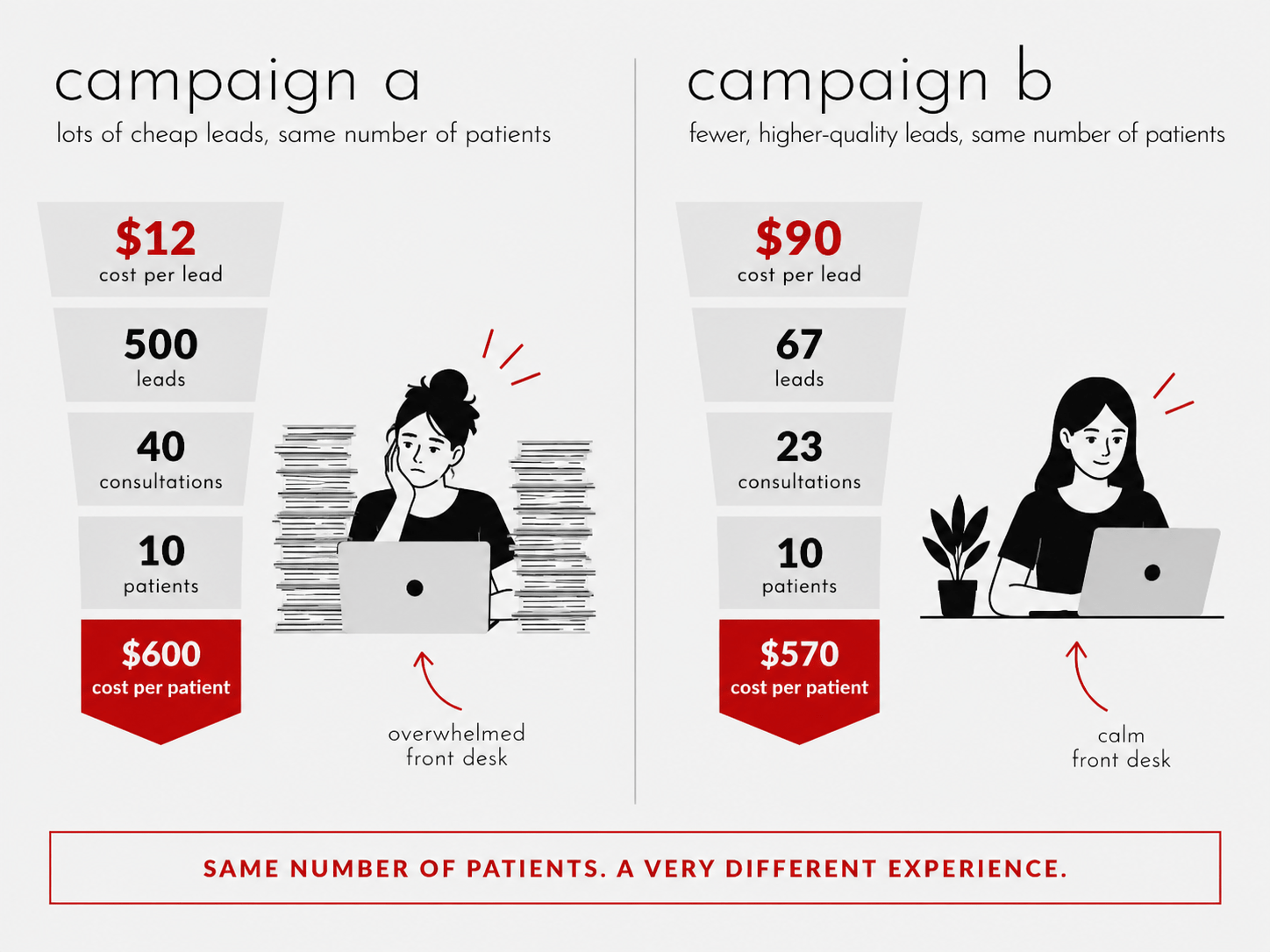
Nearly identical on acquisition cost. Every practice owner looking at those two campaigns picks A, because $12 looks like a bargain and $90 looks like someone is wasting their money.
But look at the labor. Campaign A requires your front desk to work 500 leads to get 10 patients. Campaign B requires them to work 67. Same patients, same cost, and one of them consumes seven times the staff hours and burns out the person doing it. That hidden line item is why the cheap-lead campaign so often feels like a failure — not because the leads were bad, but because the volume of unqualified calls is exhausting and everyone remembers the bad ones.
And notice what that $600 acquisition cost means against a $7,000 procedure with real repeat value. That’s an excellent campaign. If you’d judged it on lead quality alone, you’d have shut it off.
Two more things worth saying here. Give it enough volume and enough time before you decide — a couple of weeks of data on a new campaign has told you approximately nothing, and Meta’s learning phase means the early numbers are the worst ones you’ll see. And if nobody at your practice has ever measured what happens to a lead after it arrives, then what’s being evaluated isn’t the campaign. It’s a guess, and the ad account is taking the blame for it.
Where to start
Don’t do all of this at once, and don’t change five things in the same week — you’ll have no idea what worked.
Day one. Turn off Audience Network, fix the form type, and get your callback time under five minutes. This is housekeeping and it’s free.
Week one. Measure. Get the four numbers, and stop deleting leads that didn’t answer. You may discover there’s no problem to solve, which is the cheapest outcome available to you.
Weeks two and three. Work on the creative. Put the qualifying language — price, location, candidacy — into the ad itself, and accept that your cost per lead is going up and your cost per patient is going down.
Weeks four through six. Build the trust layer. A real landing page for the higher-ticket offers, video content to a cold audience, a retargeting audience you make your actual ask to, and a nurture sequence for everyone who didn’t book on the first call.
Are Facebook lead ads worth it, or should I use a landing page?
Depends on price point. Under a few hundred dollars, instant forms are fine. For four- and five-figure procedures, a landing page will produce fewer, better leads, because the prospect can answer their own objections before they raise their hand.
Why did my lead quality suddenly drop?
Check for a placement change first — campaign edits can silently re-enable Advantage+ placements. After that, look at whether a new creative started winning delivery. A discount-led ad that outperforms on cost per lead will quietly take over your budget and drag quality down with it.
Do qualifying questions raise my cost per lead?
Yes, and that’s the point. You’re paying more per lead to pay less per patient.
How long should I keep following up with a lead that hasn’t booked?
Longer than you are now. For elective procedures, months of light-touch nurture is normal, and a meaningful share of bookings come from people who first raised their hand a season or two earlier. Stop calling after a handful of attempts, but don’t stop emailing, and don’t remove them from retargeting.
How many leads are normally unreachable?
It varies too much by offer and speed of follow-up to give a number worth trusting. Measure your own, then work on shrinking it — most of what looks unreachable is a follow-up cadence problem, not a bad number.
What’s a normal lead-to-patient rate for Facebook?
Lower than search, and that’s expected. Chasing a search-like percentage on interruption traffic will lead you to shut down profitable campaigns. Judge cost per patient instead.
Can I get money back from Meta for fake leads?
There’s a mechanism for reporting invalid leads, but treat it as cleanup rather than a strategy. Prevention through placements and form friction is where the return is.
Will turning off Audience Network reduce my lead volume?
Usually yes, and your cost per lead will rise. Watch what happens to booked consults — in most accounts they don’t move, which tells you what those leads were worth.
The bottom line
Work it in order. Clear the platform settings, because they’re quick and occasionally they’re the whole answer. Then ask whether your ad is making the right promise to the right people, whether you’ve given a stranger any reason to believe you, and whether the leads you’re calling bad are actually producing patients at a cost you’d be thrilled with if you ever calculated it.
Most of the time, it’s the second or the third. And the single most expensive habit in practice marketing is deleting a qualified lead because they weren’t ready the week you happened to call.
