

Let’s talk about search engine marketing for healthcare.
Look, if somebody needs a radiologist, they are using a search engine to find one in many cases.
At the same time, however, Google Search and the entire way that we find things online has been changing quite significantly over the last couple of years.
Also, the 2024-2025 Department of Justice lawsuit against Google taught us a lot about their inner workings, and these AI overviews that are showing up in the search results have kind of turned a lot of our tactics upside down over the last two years.
And just to complicate matters, HHS issued a bulletin a couple of years ago basically stating that the mere presence of Google Analytics on your website constitutes a HIPAA violation.
This has some big implications if you’re doing Google Ads.
The Two Pillars: Organic vs. Paid Search
All right, so let’s get into it.
There are two halves to search engine marketing: organic and paid.
In other words, SEO and Google Ads.
But both have ultimately the same goal.
When someone performs a search like “endocrinologist Cherry Hill,” you want to be the endocrinologist that gets found:

That could be through the organic search results, but it can also be from these ads that show up at the top of the page.
Understanding Your Patient’s Search Intent
All right, so let’s talk about the big-picture strategy of each of these.
I’m not going to get into the weeds about how to do each one of them; the goal here is more to help you with putting together your marketing mix.
At any given point, somewhere in the ballpark of about 3% of your patients are actively looking for whatever it is that you do in your market.
About another 17% are actively collecting information, maybe doing research about whatever their concerns are, and they may soon join that 3%:
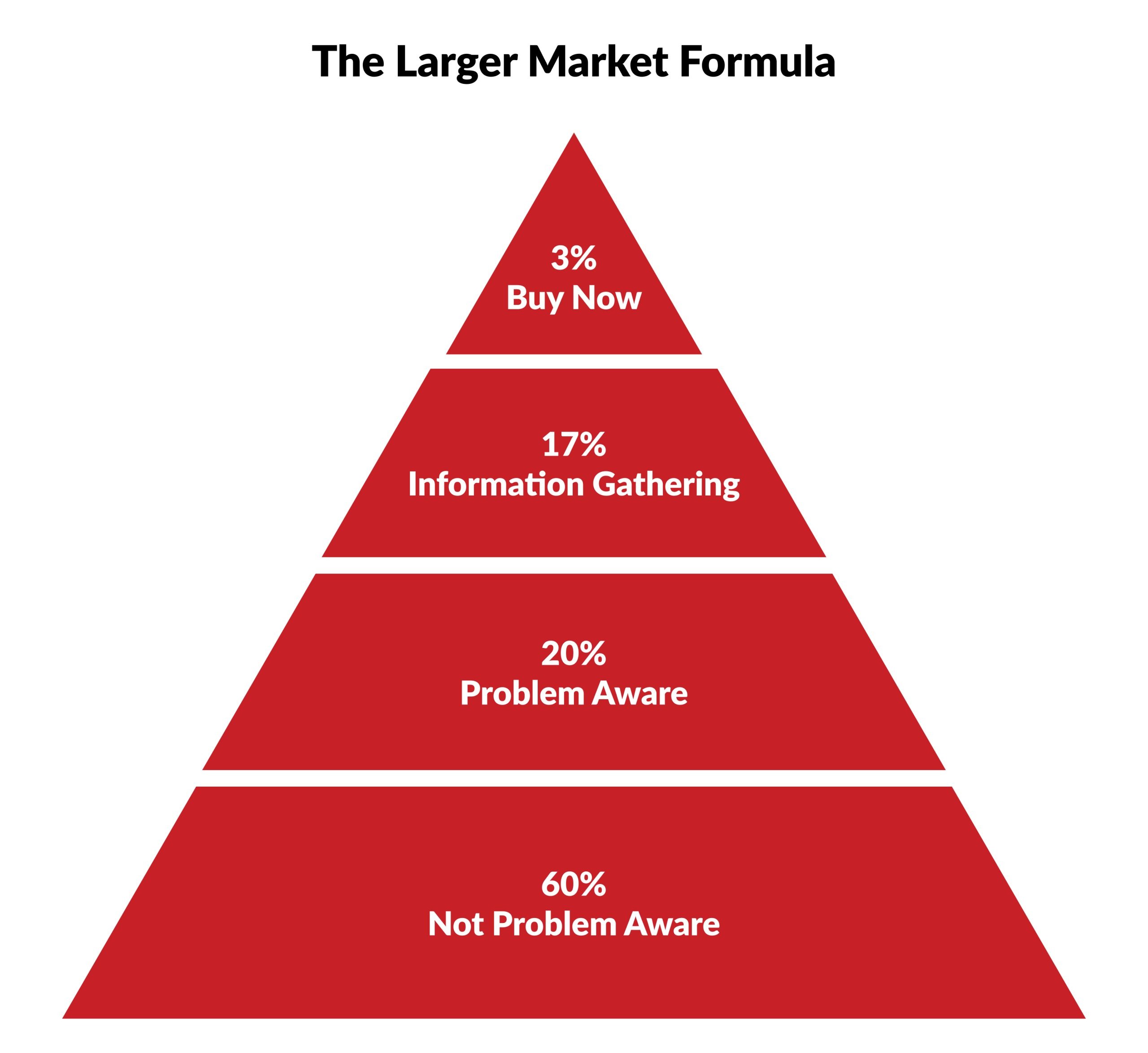
Search engine marketing for healthcare can help you to get in front of this 20% of your market.
Below that, you have the people that are “problem aware” and “problem unaware.”
They have not really taken any steps yet to gather any information.
Social media is probably the place to get in front of them.
Search Engine Optimization (SEO): The Long-Term Equity Play
All right, so let’s get into the two pillars of healthcare search engine marketing.
First, SEO.
SEO is the long-term equity play.
It’s probably the only channel that doesn’t stop working when you stop investing in it.
The upfront costs usually are more than they’ll be for other channels, or at the very least, they have a longer payoff period, so fewer healthcare providers end up actually investing adequately.
However, practices that rank well in organic search will find that this will have the lowest patient acquisition cost of any channel that’s available to them, other than word of mouth.
So much so, we had a telemedicine platform we started with a few years back.
They were spending $75,000 a month on ads, and they gave us a $10,000 a month SEO budget.
Within six months, they did a return on investment analysis, and the return on their SEO spend was so much better than it was for Google Ads that they completely cut out the $75,000 a month Google Ads spend for years and then put another $5,000 a month toward SEO.
Google Ads (PPC): The Immediate Revenue Driver
Now, pay-per-click (PPC) on the other hand—Google Ads—is the immediate revenue driver, or relatively immediate.
You know, you can start Google Ads and basically within a day or two start seeing your ads pop up right at the top of the search results:

This is not going to happen with SEO, which also makes it a lot easier and faster to be able to iterate on what you’re doing.
With Google Ads, you may be sending this traffic to a landing page that’s not particularly well-optimized, and you’ll find that out quickly.
With SEO, it might take a little bit longer.
The Downsides of PPC
All right, so what are the downsides of PPC?
Well, if you’re competing in any sort of mature market, it may have already become a “who can spend the most to bring in a patient” scenario, in which case it may be quite difficult to make it profitable for your practice.
The second downside to it: the second you stop spending money on it, crickets.
Now, there’s one other disadvantage of PPC that I want to bring up.
Google Ads very often gets the attribution for what’s getting done with brand and reputation.
Generally speaking, the people that are scrolling down to the organic search results—you know, the ones that scrolled past the ads that are looking at the maps, clicking on reviews, maybe even scrolling past there and going down to the blue link results at the bottom of the page—these are the people that are doing their research:

Often the people that end up clicking on these ads at the top of the page are really just either clicking on the first thing that they saw, or clicking on someone that they recognize that they would have already clicked on if they had just continued scrolling down.
How AI is Changing Healthcare Search
All right, so how has AI changed all of this?
Google Ads has not been particularly affected, and I don’t think it’s going to be.
The vast majority of Google’s stock price depends on Google Ads delivering and being profitable for them, and they’re not going to upset Wall Street.
SEO, on the other hand, has been quite affected.
Searches where people have transactional intent—we actually did a study this year that showed that 69% of AI mode sessions end up visiting the website when someone has transactional intent.
In our case, they were looking for doctors specifically.
So, the SEO strategies from a couple of years ago where they were advising you to write lots of blogs—there’s a tiny fraction of that that still works.
I have an entire video about it:
Generally speaking, informational blogs are a waste of time and resources.
Key SEO Concepts: E-E-A-T and YMYL
All right, so next let’s talk about some key concepts and winning strategies that you are going to need to navigate all of this.
All right, starting with SEO: E-E-A-T (Experience, Expertise, Authoritativeness, Trustworthiness).
These are the four things that Google is looking at with your website in particular because you are in the medical field.
Healthcare websites fall under what Google refers to as “Your Money, Your Life” (YMYL).
This means they go through a “baby algorithm” of sorts, and they want to see that the person that wrote the content has firsthand experience with the topic.
They want to see that they have a certain level of expertise.
Google is using machine learning to understand whether the author of an article is a doctor, a well-informed layperson, or a crackpot spreading even more medical information online.
The Authority and Trust Components
Now, the authority component of this: Who wrote it?
Where else have they written?
What are their credentials?
Was this content medically reviewed by a professional?
And lastly, trustworthiness: Is there anything on this website that should make us not trust it?
So you see that chart there:

That was a client that we started working with a couple of years back where we ended up having to go through their blog and delete a whole bunch of really questionable content written by someone that really had no idea what we were talking about.
Those pages were actually causing the entire website to tank in organic search when new algorithm updates were rolling out.
Once we got rid of them, it was all taken care of.
When Content Marketing Still Works
The next important concept is content marketing.
Now, I said earlier that you shouldn’t be writing blogs.
That’s not totally true.
You probably shouldn’t be writing blogs about topics where people don’t care about whether you have firsthand experience with the topic or not.
“What is flu?”—Google’s AI overview can answer that.
“Do you really need to take finasteride if you get a hair transplant?”—there’s a good chance you’re going to want to hear from doctors and from people on Reddit that have done so or not.
Those topics are okay to still produce content around.
As a matter of fact, they are a great opportunity to get in front of patients as they’re collecting information online—that 17% that I mentioned earlier.
As you’re doing this, however, incorporate video into this strategy.
Just like you’re watching this video right now and you’ve probably got a sense for who I am and what we’re about here at Saga Pixel, the same thing happens with your patients.
The next concept to understand is technical SEO.
There are ways that you can structure your website that will help the internal pages to rank better or worse.
And lastly, backlinks.
When websites link to your website, Google sees each of those as a “vote of confidence,” so to speak.
And the way that you link between the pages on your own website distributes that trust signal throughout your website.
Getting all of this right is a key part of SEO.
Advanced Google Ads Strategies for Healthcare
All right, let’s get into the Google Ads.
First, your campaign structure.
You are not only going to organize your ad groups by service line; you’re going to organize them by search intent.
All right, so in the case of a plastic surgeon, you may have a “rhinoplasty” ad group and you may have a “rhinoplasty cost” ad group.
One is going to go to a landing page that is focused more on the plastic surgery, and the other one more on the pricing and financing.
And then the same thing for facelift, chin lipo, maybe another dedicated campaign just for regular lipo, and then another one for BBL.
The goal here is to maximize the relevance of the content on the landing page to the keywords that you’re bidding on, and frankly, to put the right content in front of the person that clicked on the ad in the first place.
Eliminating Waste
Second, our approach at Saga Pixel when it comes to Google Ads is to become relentless about eliminating waste.
There are keywords that you are paying for that don’t convert.
There are age groups that are seeing your ads that aren’t going to convert.
There are days of the week where your ads don’t convert as well.
Same goes for times of day and income levels.
You want to go into your account and find every single aspect of that account that is waste, and prevent the ads from delivering to those people, at those times of day, and in every other dimension.
Most of us are adding negative keywords.
Navigating Search Marketing in a HIPAA World
Now, how do you do all of this in the world of HIPAA?
SEO is a lot more straightforward.
While you can’t really use Google Analytics right out of the box, you can use server-side tagging to strip out all the PHI (Protected Health Information) and send that back to Google.
The more complicated part is with Google Ads.
As you are stripping out all of that data, you’re also stripping back your conversion data.
This means Google, in turn, is less capable of optimizing the delivery of your ads because now we’re not telling them who’s converting or who our ideal patient is.
So, it will struggle more to deliver the ad to the right person, which makes the addition of negative keywords and manually doing everything you can to the account critical.
