

62% of Google AI mode users with transactional intent talk to it the same way they talked to Google in 2009.
Every SEO conference I attended this year featured speakers stating that people don’t search on LLMs the way they do in Google Search.
We just wrapped a UX study of how people use Google AI Mode and we observed the opposite to be true.
Most users are not talking to AI with natural language when they have transactional intent.
Many of the conclusions SEOs have drawn about maximizing visibility in LLMs are being misguided by this oft-repeated misconception.
This being the case, the monitoring of brand visibility for a company’s most valuable search terms—transactional searches—will face much less of a challenge than is currently portrayed.
Background of the Study
We spent 21.7 hours watching 52 people from across the US and Canada find 141 local service providers.
We asked participants to imagine they were in 3 fictitious scenarios and to act exactly as they would if they were not being observed.
In all three scenarios, we instructed the participants to complete the following tasks:
- Find a new dentist.
- Find a place to get Botox for the first time.
- Find a dermatologist to check out a mole you’re concerned about.
Their ages were as follows:
| Age Range | Number of Participants |
| <30 | 23 |
| 30-50 | 20 |
| 50-65 | 8 |
| 65+ | 1 |
Participants were instructed to act exactly as they would if they needed to personally find these services. The sessions began in AI mode, but participants were told to use it naturally—which even resulted in instances where users switched over to traditional Google and Instagram.
We then reviewed the prompts entered into Google’s AI mode and categorized each session as having used:
- Keyword-based search
- Natural language
- A hybrid approach (some switched between keyword-based prompts and natural language as they asked follow up questions)
This is the raw data, along with logs of the actual searches participants performed
Results of the Study
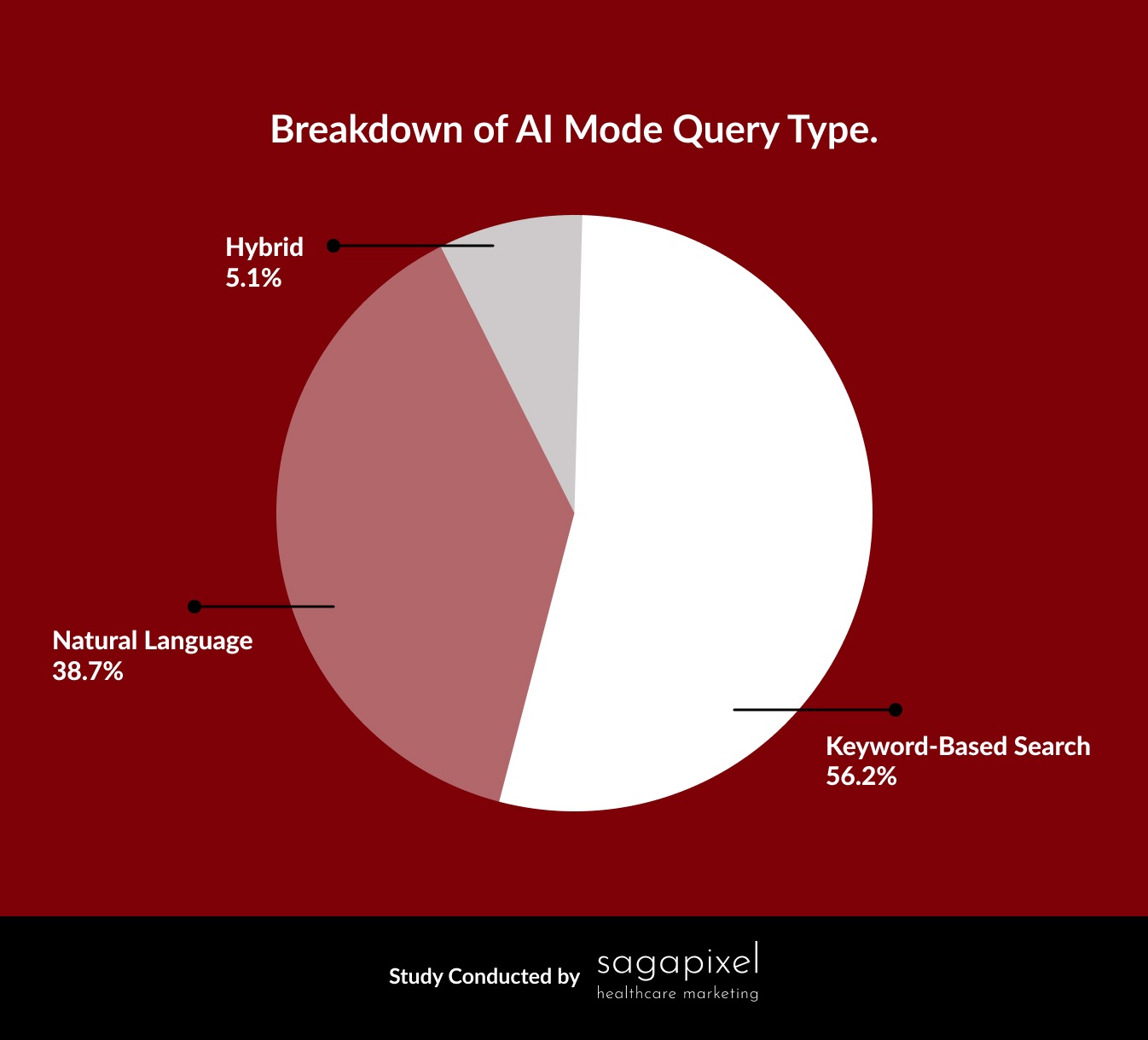
56.2% of participants proceeded to perform keyword-based searches instead of using natural language to prompt AI Mode such as:
- “Dermatologist”
- “dermatologist in spart nj”
- “dermatologist for mole”
This might not be the case when they’re looking for information, but when they are ready to spend money, 38.7% of them type:
- “I’m looking for a dermatologist that’s near me, I have a new mole on my face that i’m concerned about”
- “i woke with a mole and i need to get it checked out. Can you suggest dermatologists around my area here in connecticut”
A remaining 5% used a mix of keyword-based and natural language prompts, with one such session being:
- dentist in portland oregon
-
- only need dentist and can you make a table comparing these
- dentist must take ohp health insurance
50%+ of the Time, Keyword Tracking Is Possible
This conclusion about how people are talking to LLMs has far reaching implications for GEO/AISEO.
In the case of searches with transactional intent, more than half of our target customers are still using the search terms we’ve tracked for the last 30 years in SEO.
One of the main criticisms of LLM trackers is that people search in too many complex ways for any of it to be tracked.
This data shows this to not be the case in at least 50% of cases involving searches with transactional search intent.
