

If you’re trying to grow your home care agency with more qualified leads and more caregiver applicants—without paying for every click, this guide is your playbook.
I’ve been doing SEO for home care agencies since 2018.
I speak regularly in the industry about what actually works.
In this article, you’ll learn the exact strategy agencies use to show up in Google’s map results and the organic listings, so families can find you when they search for services like home care, Alzheimer’s/dementia care, overnight care, and 24-hour care—and so job seekers can find you when they’re looking for caregiver roles.
By the time you’re done reading, you’ll know:
- Which pages you need on your website (and which ones are a waste of time)
- How to expand visibility into the towns you serve with location pages that actually rank
- How to structure internal linking so your most important pages don’t get stuck on page three
- How to format pages to convert more calls, forms, and booked consultations
- How to approach reviews, schema, blogging, and link building in a way that drives results for home care
If you want a clear, step-by-step path to getting found—and turning that visibility into revenue and staffing—start here.
What Is SEO for Home Care?
Home Care SEO (search engine optimization) is a digital marketing channel that aims to get a home care agency found when families search for senior care services.
The goal of SEO is to get found in the local map results and the 10 blue links below:
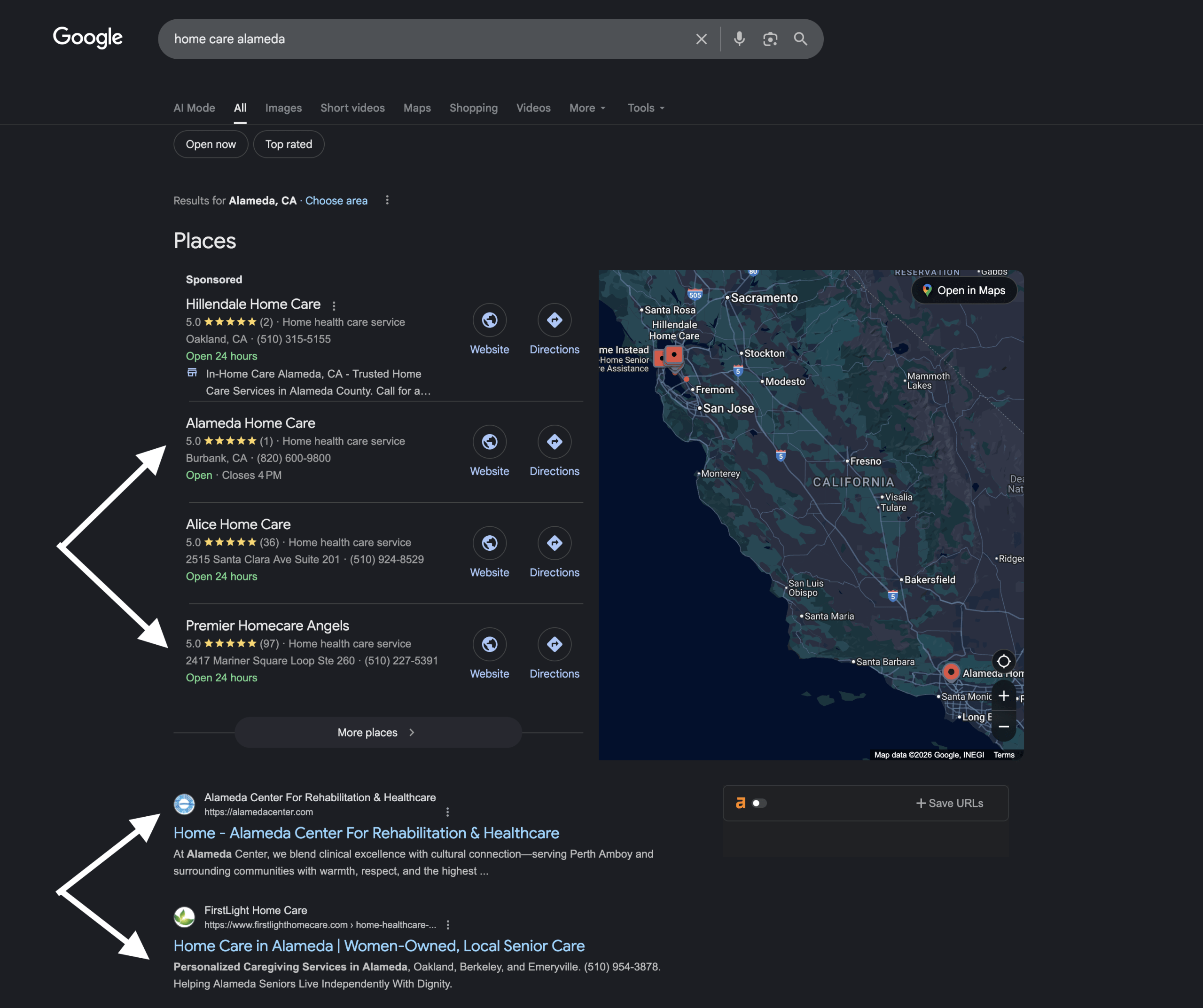
SEO can drive some of the least expensive leads for your home care agency—and it can also become a recruitment channel for caregivers. In plain English: SEO helps your website and Google Business Profile show up when families (and job seekers) search on Google, so you earn more calls, form fills, and booked consultations without paying for every click.
Home care is one of those industries where people are already searching with urgency:
- “home care agency near me”
- “24 hour care”
- “Alzheimer’s care”
- “overnight caregiver”
- “paying for home care”
If you’re not visible for those searches, you’re missing out on revenue and traffic that’s actively trying to find what you do.
How Home Care SEO Works
Effective SEO for home care agencies has three parts:
1) Make your website easy for Google to crawl and index
If Google can’t reliably crawl your pages, your on-page work won’t matter. This includes technical SEO basics plus site architecture—structuring your website so Google can find your important pages and understand how they relate.
A big part of this is internal linking: Google discovers pages through links, and links also pass authority (PageRank). The goal is to make sure your service pages and location pages are easy to find and reinforced by internal links.
2) Maximize relevance to what people actually search
Ranking “on Google” isn’t a goal by itself. Ranking for the right searches is.
For home care, that means you need pages that match real intent:
- If someone searches overnight care + your city, you should have a dedicated page optimized around overnight care in the geography you serve.
- If someone searches how to pay for home care in your state, you should be the agency answering those questions (if you want that business).
- If you serve many towns (you almost certainly do), you need location-targeted pages so you can show up across your service territory.
3) Build trust signals that make Google (and humans) believe you
Google leans heavily on signals of trust and authority:
- Backlinks (links from other websites) act like votes of confidence.
- On-site trust—reviews, proof, strong messaging, clear services, helpful content—supports conversions and engagement.
- How people interact with your site matters. If users land, engage, and don’t bounce back to search results, that can support stronger performance over time.
Local SEO for Home Care
Local SEO is how you show up when someone searches a service + location (example: “home care agency Hamilton NJ”). In home care, local visibility can become one of your highest-leverage lead sources.
There are two places you can show up:
1) The map results (Google Business Profile)

These map listings often get a large share of clicks. Your Google Business Profile is also where families verify trust—reviews, photos, videos, and basic business details.
What to focus on in your Google Business Profile:
- Reviews are critical. If competitors have dozens of reviews and you have a handful, you’re fighting uphill.
- Have a review acquisition process. Ask after you know the family is happy.
- Real photos win. Use pictures of real people and your real office/team. Stock photos signal “generic” and reduce trust.
- NAP consistency (Name, Address, Phone). Your GBP details should match your website and your structured data (schema).
- Complete the profile. Categories, services, hours, description, social profiles.
- Google Posts won’t magically boost rankings, but they can catch attention and increase engagement.
One important reality: for home care, map visibility is often limited to a tight radius. That’s why you want both map visibility and strong organic rankings in the “blue links.”
2) The organic “blue links” under the map
These are your website pages ranking organically. This is where strong service pages, location pages, internal linking, and content do the heavy lifting—especially across wider territories.
The Home Care SEO Playbook
Below is a practical SEO playbook built around what people actually search for in home care—and what tends to generate leads (and caregivers).
Step 1: Build the service pages people actually search for
Start with dedicated pages for high-intent services:
A. Your core “home care + location” page
This is usually your primary service page (often the homepage or main service landing page). Optimize it around:
- Home care + your main region (or home care + city if you’re in a major city)
- Include natural mentions of related terms people use, like senior care and caregiver (these should appear in headings and body copy, not stuffed)
B. Dedicated pages for high-demand sub-services
Create separate pages targeting the searches that show up again and again:
- Alzheimer’s / dementia care
- 24-hour care
- Overnight care
- Live-in care (even if you don’t offer it, it can be valuable to address the intent clearly—what you do offer, alternatives, and how to get help)
- Veteran care (often a strong keyword opportunity)
C. Don’t overbuild low-intent standalone pages
Many agencies waste time creating individual pages for every micro-service (transportation, respite, etc.). In many markets, you’re often better off mentioning these services inside your core service pages rather than trying to rank a standalone page for a term that barely gets searched.
Step 2: Create location pages for the towns you serve
Families search locally. If you serve multiple towns, you need pages targeting those markets—even if your office isn’t physically in each town.
Example: You might be located in Cherry Hill, but you can rank for nearby towns by publishing pages built for those towns.
Rules for location pages:
- They must be completely unique. Don’t copy a page and just swap the city name.
- Thin or duplicated location pages can fail to index—and in worse cases can drag down overall site performance.
- Make them thorough and useful: talk about the service, how it works, who it’s for, what families should expect, and local relevance (without awkward repetition).
Step 3: Internal linking is the difference between page one and page three
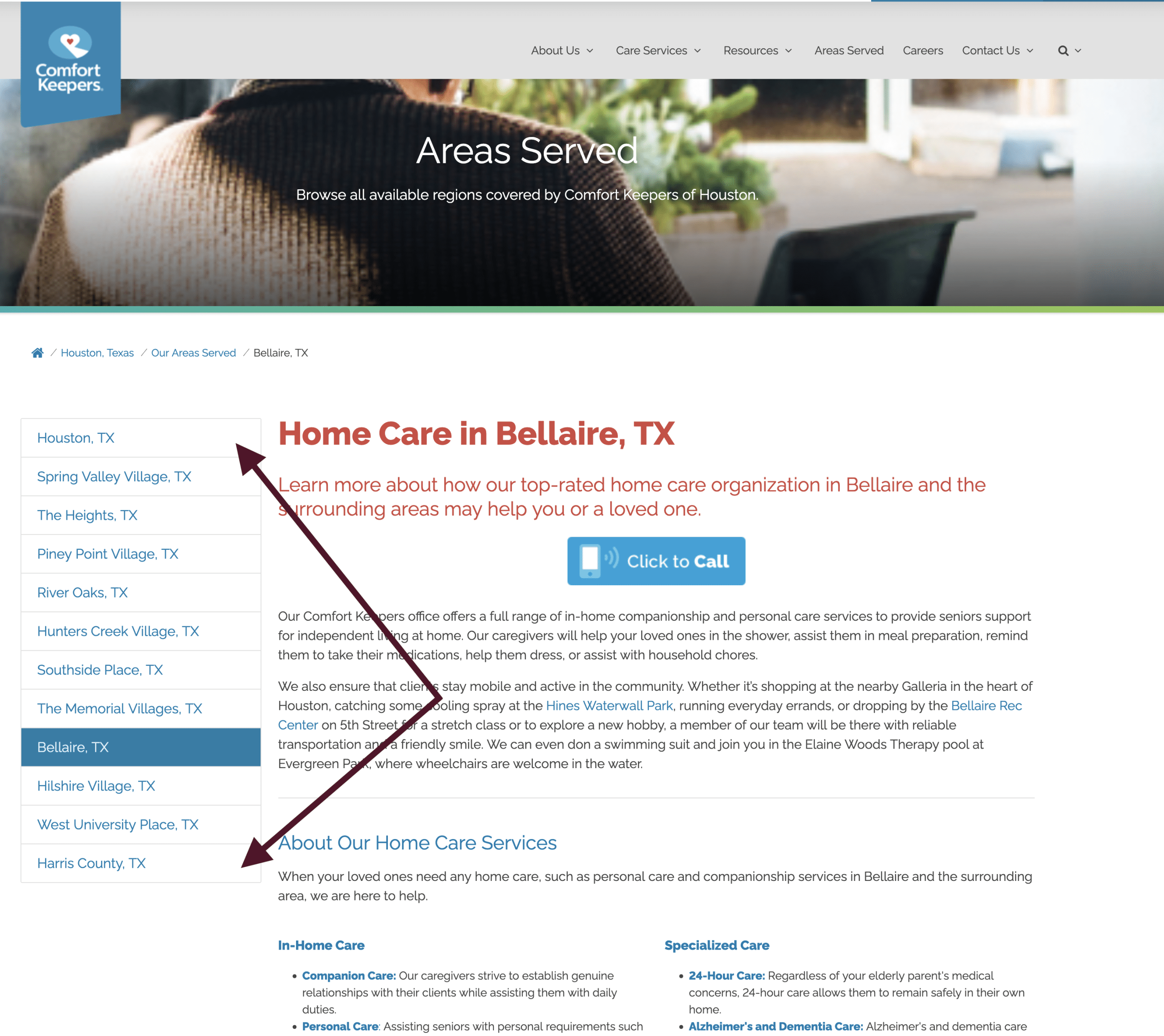
All of your city pages and service pages should intentionally link to one another.
What to do:
- Link from service pages → relevant city pages
- Link from city pages → relevant service pages
- Build “communities we serve” sections that actually help people navigate
Comfort Keepers does this as part of their SEO efforts:
What not to do:
- Don’t rely only on footer links.
- A strong approach is a homepage module/section that links out to location pages—so as the homepage earns authority (including from backlinks), it passes link equity into the pages you’re trying to rank.
Step 4: Format pages to convert (SEO is only half the battle)
Getting discovered isn’t the finish line. You want people to take action.
A high-performing service/location landing page often looks like this:
- Hero section
- Clear messaging (make this the dominant element)
- Target keyword in an H1
- Two CTAs: one to get information and one to book an appointment (even better if you can send them to a scheduling link)
- Sticky CTAs
- Desktop: sticky CTA can boost conversions
- Mobile: tap-to-call and tap-to-get-info are essential
- Social proof immediately below the hero
- Reviews, years in business, affiliations, outcomes—whatever makes you trustworthy
- Service details + differentiators
- What you do, who it’s for, how it works, what happens next
- Objection handling + FAQs
- Minimum hours
- Insurance vs private pay
- Availability
- Screening/training
- Getting started timeline
- Alternative offer
- A guide to choosing a home care agency
- A guide to paying for home care
- A caregiver recruiting offer if the page is job-focused
When people engage with your site (instead of bouncing back to Google), it’s a strong signal that they found what they were looking for.
Step 5: Add schema markup (especially Area Served)
Schema is structured data that helps search engines understand your business details. It won’t replace strong content and links, but it can support relevance and clarity.
One of the most impactful things for multi-town home care SEO is AreaServed schema on your location pages:
- Mark each location page with the city it targets
- Keep your NAP consistent across GBP + website + schema
Step 6: Blogging (only if you do it with purpose)
Blogging has limited effectiveness for most home care agencies—unless you focus on topics that drive real leads or recruiting.
Two content pillars that can work:
- Paying for home care / assistance programs
- State- and program-specific content can drive highly qualified leads
- It also builds trust and gets people into your CRM early
- Caregiver recruiting content
- “How to become a caregiver in [state]”
- Requirements, pay, onboarding, training
- Even “best paying home care agency + location” can become both recruiting and lead gen (in some markets caregivers bring the case)
Optional third pillar:
- Stats/reference content designed to earn passive backlinks over time (more on that below)
What to avoid:
- Generic caregiving tips (they pull in low-intent traffic from everywhere, and they don’t convert locally)
Step 7: Link building that works for home care agencies
Google uses backlinks to judge authority. The best links are from real, reputable websites.
What tends to work:
- Sponsorships
- Local little league, community groups, nonprofits—often leads to a legitimate link and local visibility
- Digital PR / doing something newsworthy
- Publish data, a community initiative, or a meaningful story that local or industry publications want to cover (with a link)
- Passive link earning via statistics/reference content
- People search for numbers and citations. If your page becomes the reference, it can earn links naturally over time.
What to avoid:
- Low-quality link packages
- Fiverr link building
- Scaled guest post campaigns (often a waste of money and riskier than people realize)
What To Do First (In Order)
If you want a simple priority list:
- Google Business Profile + reviews + real photos + NAP consistency
- Core service page + high-demand sub-service pages (Alzheimer’s/dementia, overnight, 24-hour, veteran care)
- Location pages for the towns you serve (unique content)
- Internal linking system that connects all service + city pages (don’t bury links)
- Conversion upgrades (CTAs, sticky actions, social proof, FAQs)
- Schema markup, especially AreaServed
- Selective blogging (paying for care + caregiver recruiting)
- Link building (sponsorships, PR, stats/reference assets)
Sagapixel Offers Home Care SEO That Drives Leads (and Can Support Recruiting)
If SEO feels overwhelming—or you want a team that already understands what works in home care—Sagapixel can help. We’re a digital marketing company with extensive experience driving leads through home care SEO, including building the service + city page strategy, internal linking systems, conversion-focused landing pages, and the trust signals that help you win.
If you’d like to talk about your home care SEO strategy, call 856-701-7947 or schedule a time through our website contact form.

