

We Completed The First Study of User Behavior in AI Mode for Transactional Searches
Google’s AI Mode—or something resembling it—is almost certainly the future of how we find businesses. Naturally, the SEO industry is panicked about what this means.
The prevailing narrative, backed by a few early studies, is that “AI doesn’t send traffic.”
But there is an important detail in these studies that we are not discussing or exploring: none have focused on transactional search intent.
They provide a valuable insight: people won’t visit a website when they just want an answer that AI can provide.
But what about when they are looking for a local business, a vendor, or a healthcare provider?
Does that decision happen entirely inside AI Mode?
Is “Zero-Click” marketing the future of everything, or just the future of facts?
Let’s take a step back here: the most valuable clicks we can drive are those where customers want to transact with a business.
We need to understand this customer behavior within AI Mode.
This is why our team completed the first UX study focused on these types of searches.
The results don’t just tweak the current narrative—they shatter it.
Here is the truth: the “Zero-Click” apocalypse applies to facts, not businesses.
Key Takeaways
|
Only 27% of users felt ready to make a decision based solely on the AI summary. Users use AI to build a list, but they visit the website to finalize the decision.
Background of Our Study
We set out to answer the questions no one else was asking: when people search for businesses and services, do they stay in AI Mode or do they visit the website?
We spent 21.7 hours watching 52 people from across the US and Canada find 141 local service providers.
Their ages were as follows:
| Age Range | Number of Participants |
| <30 | 23 |
| 30-50 | 20 |
| 50-65 | 8 |
| 65+ | 1 |
We asked them to accomplish three specific transactional tasks:
- Find a new dentist.
- Find a place to get Botox for the first time.
- Find a dermatologist to check out a mole you’re concerned about.
Participants were instructed to act exactly as they would if they needed to personally find these services. The sessions began in AI mode, but participants were told to use it naturally—which even resulted in instances where users switched over to traditional Google and Instagram.
We chose medium-to-high involvement purchase decisions. A future study may include low-involvement decisions (like “flu shot near me”), which we suspect are more likely to be zero-click decisions.
This is the raw data, along with logs of the actual searches participants performed
This is what we learned.
What Percentage of Google AI Mode Sessions Result in a Website Visit?
“AI doesn’t send traffic” has been the doom-and-gloom headline of the SEO industry for months.
Our findings contradict this entirely when focusing on transactional queries.
69% of AI mode sessions clicked through to the websites before making a decision.
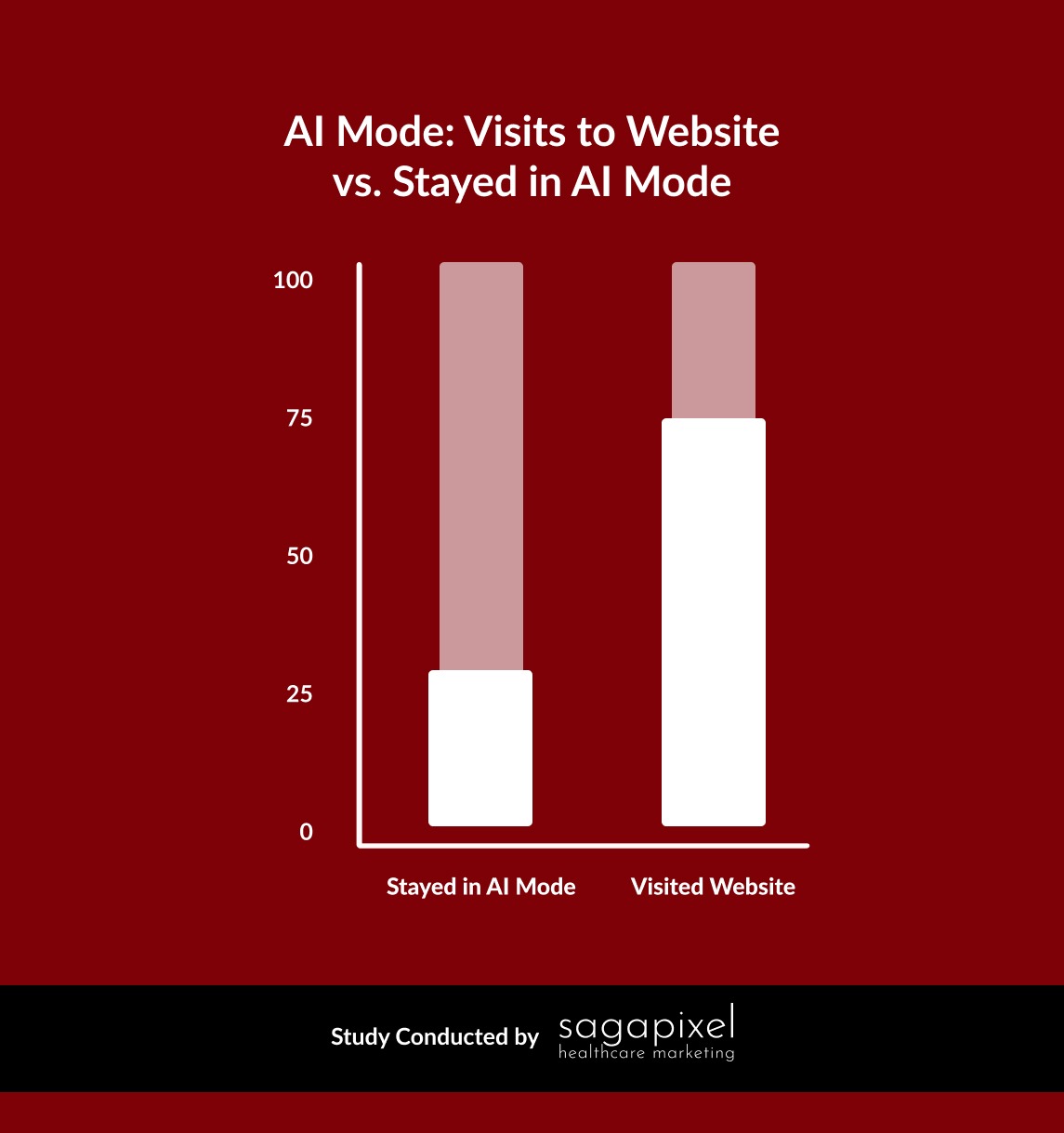
27% of participants felt satisfied and “ready to make a decision” with the information they found in AI Mode alone (others checked social media and traditional Google).
Business websites are not obsolete.
At the same time, there are people that trust AI enough to help them to decide where to get needles in their faces.
Being #1 Is Not “Winner-Takes-All”
On average, the participants in our study checked 3.7 results in AI mode, with 89% clicking on more than one business.
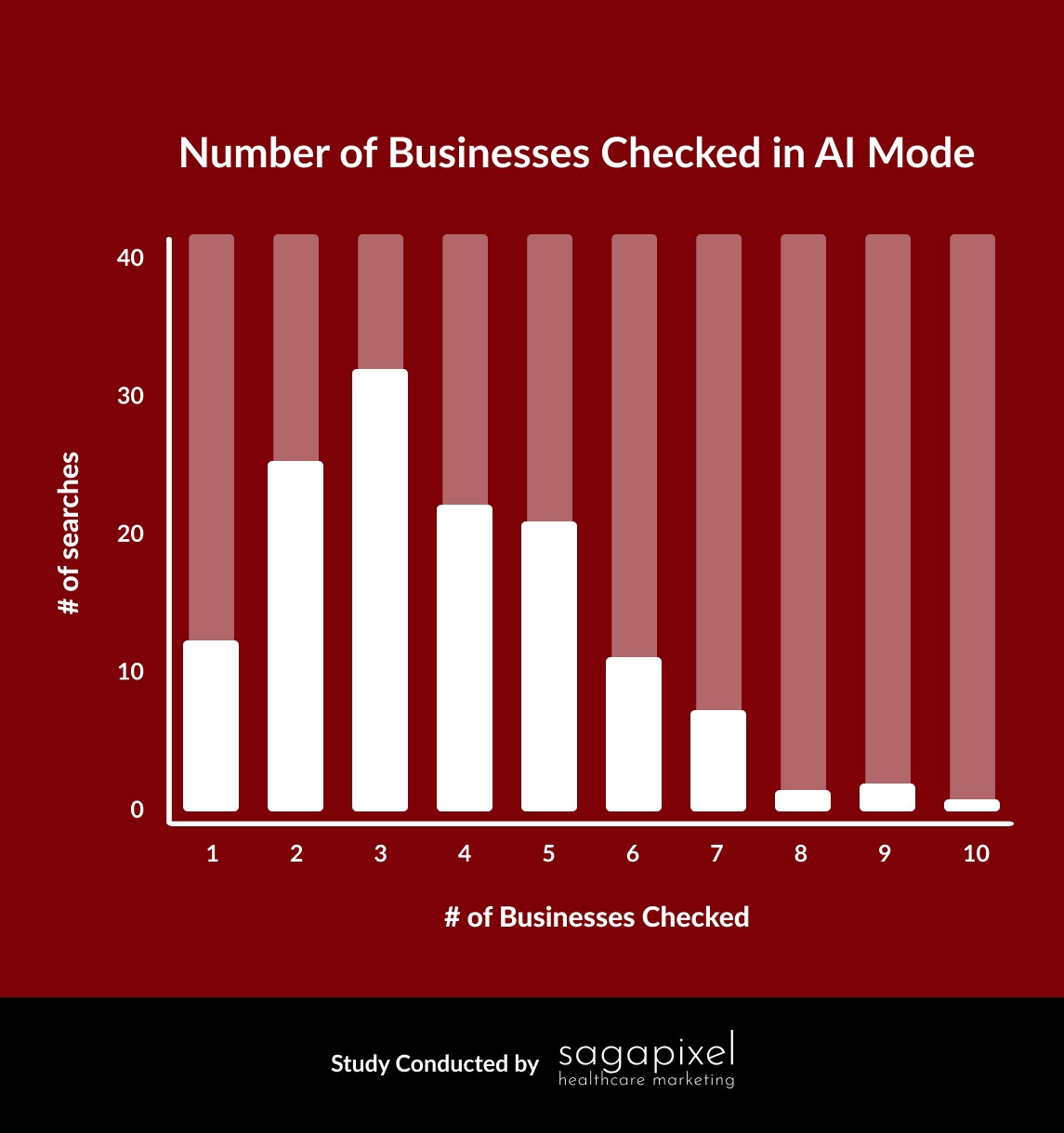
You read that right: only 1 in 10 AI mode users only clicks on one result.
People are not using AI Mode to be provided a single recommendation; they are using it to curate a list of options to choose from.
This change in behavior has massive implications for SEO. “Ranking #1 on Google” is valuable when it means you get 25%+ of the clicks. But AI Mode doesn’t appear to be the “winner-takes-all” game of traditional search.
Notice how the chart above differs from the CTR charts we’ve seen over the past 20 years in SEO.
In AI Mode, the goal is to be included in the response and stand out enough to be one of the 3 to 5 businesses in the consideration set.
Whether the user clicks to your website or not seems to be decided by factors other than your position among the 1-5 businesses in this set.
How Important Is It to Appear Above the Fold?
It does not appear to be critical.
84% of the participants scrolled below the fold to find answers. This is consistent with our observation that users treat AI mode as a tool to curate options for analysis, rather than a tool for “just getting the answer.”
How Common Are “One-Shot Prompts?”
Despite the hype around conversational search, 61% of searches involved the use of only one prompt.
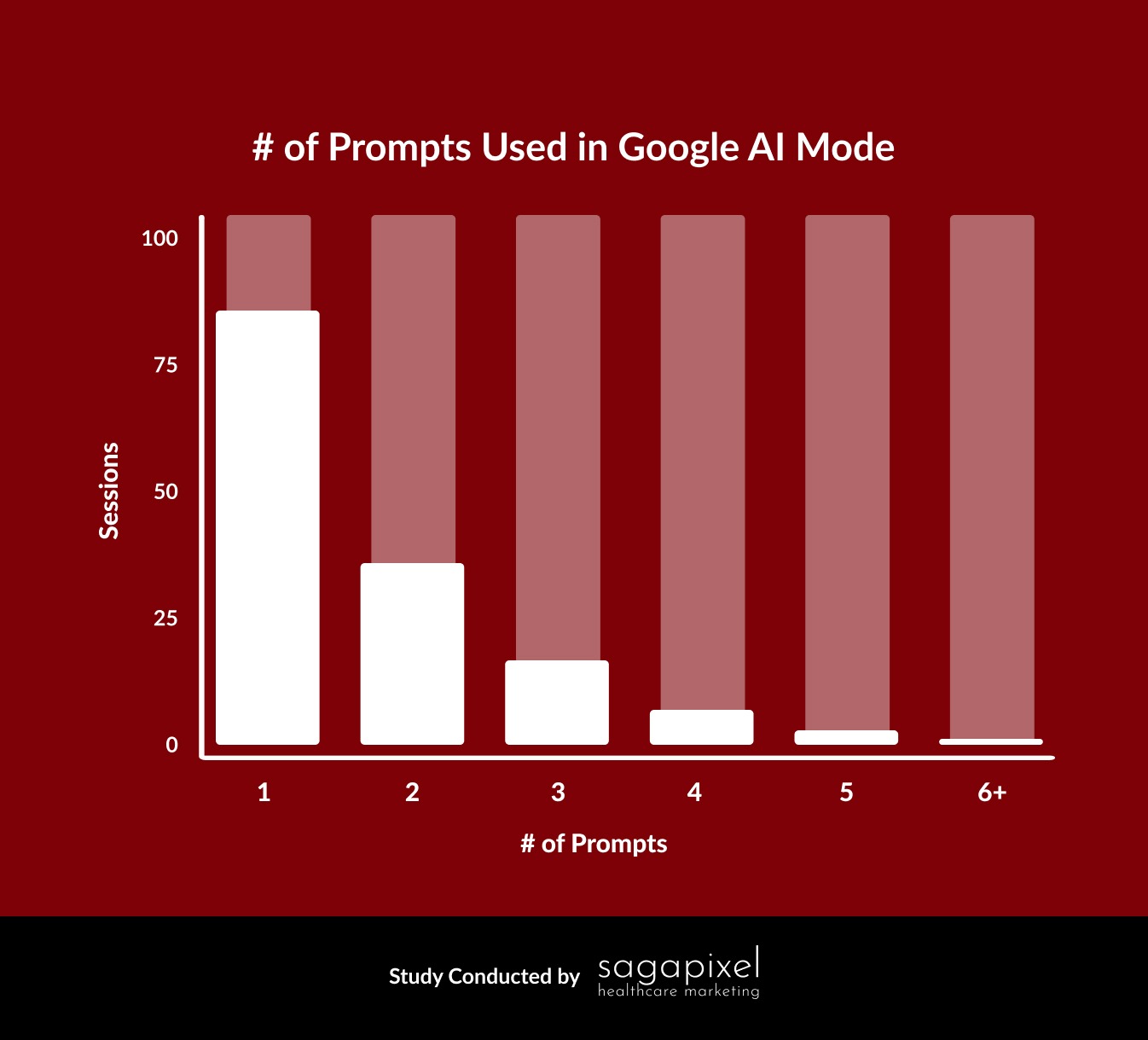
Generally, users want the AI to do the heavy lifting immediately.
What Percentage of Participants Checked Reviews?
In cases where the Google Business Profile (GBP) appeared when clicking a recommendation, 74% of AI Mode users read the reviews of the business before making a decision to contact them.
The participants’ reliance on reviews was undeniable. Social proof remains the currency of trust.
Do Users Look at Photos in AI Mode?
The answer to this question surprised us.
We specifically chose the “Botox” search because we assumed “Before and After” photos, pictures of the clinic’s interior, and photos of the staff would be critical.
We were wrong.
Only 21% of AI Mode users viewed the photos in the Google Business Profile.
There was a slight difference in views among the three searches:
- Find a new dentist – 13%
- Find a place to get botox – 24%
- Find a dermatologist to check a mole – 17%
While we still recommend adding photos to your GBP, far fewer of your potential customers are looking at them than we expected.
In the AI interface, text and reviews carry more weight than imagery.
How Long Do Users Spend in AI Mode?
On average, users spend 2 minutes and 42 seconds reviewing the results in AI Mode.
The average time spent to make a final decision on whom to contact was 3 minutes and 58 seconds.
In other words, on average, people spend a full 1 minute and 16 seconds longer in AI mode than they do on your website before making a decision.
What is being said about you in AI Mode matters
AI Mode Will Change SEO, But It Will Not End It
The era of “10 blue links” is fading, but the era of the website is not over.
When users have transactional intent, AI does not replace the search process; it accelerates the research phase. It acts as a sophisticated filter, removing the noise so the user can focus on the credible options.
This shifts the definition of “winning” in SEO:
- The goal should not be to “Rank #1.” Our goal in AI mode should be to appear in the top 1–5 results—the “Consideration Set”—where the user begins their real analysis.
- The “click” is no longer automatic. It is earned through social proof. With 74% of users checking reviews and 89% clicking multiple options, your reputation (reviews/ratings) is now as important as your technical optimization.
- The website is no longer the library; it’s the handshake. Users aren’t coming to your site to find out if you exist; they are coming to decide if they trust you.
If your business relies on informational “how-to” queries to drive business, AI Mode is indeed a threat.
But if you are a local business simply trying to get in front of customers explicitly looking for the services you provide, AI mode is not a wall between you and your customers.
It is the concierge.
The businesses that survive this shift won’t be the ones fighting the machine.
They will be the ones that understand that while AI can start the conversation, only a human—and a trustworthy website—can close it.
