

Effective local PPC management starts with showing your ads to the right people, at the right time and sending them to the right landing page.
In this guide, I’m going to talk through how to do that.
We break down an efficient workflow to dominate specific zip codes, eliminate wasted spend in low-performing location, and properly collect and leverage data.
Our PPC agency has managed millions of dollars in local PPC spend and we have developed a firm conviction: most businesses fail at local PPC because fail to prevent the waste in their campaigns.
Every Google Ads campaign is paying for:
- The wrong search terms
- The right search terms from the wrong people
- The right search terms from the right people, at the wrong time
Our goal is to prevent this.
Hyper Local Geotargeting
To win at local PPC, you have to reduce costs on your local clicks.
It is the difference between a high-CPA awareness campaign and a lean, revenue-generating local machine.

What is Local PPC? (The Foundation)
Local PPC is the strategic use of paid search to target users within a specific geographic perimeter—whether that’s a city, a zip code, or a three-mile radius around your front door. Unlike broad national campaigns, the local workflow is high-stakes and high-intent:
-
Research: Identifying which neighborhoods actually drive your revenue.
-
Geo-Targeting: Drawing the digital fences.
-
Ad Creation: Crafting copy that mentions the user’s specific town.
-
Landing Page: Delivering a local destination that proves you are nearby.
-
Optimization: Ruthlessly cutting zip codes that don’t convert.
The core benefit is simple: Decision Moment Catching. When someone searches “[service] near me,” they aren’t researching; they are buying. Local PPC ensures you are the first name they see.
Account Architecture: SIAGs vs SKAGs
Your account structure will have a big impact on the success of your campaign.
Single Intent Ad Groups (SIAGs)
While many agencies still cling to Single Keyword Ad Groups (SKAGs), we’ve found that they often create unnecessary complexity without adding performance value.
Instead, we utilize Single Intent Ad Groups (SIAGs).
The goal isn’t to match a specific string of text, but to match a specific user intent.
In a local context, this means grouping keywords that signal the same “problem-to-be-solved” in the same geographic area.
For example, instead of having separate ad groups for “plumber in Cherry Hill,” “Cherry Hill plumbing services,” and “local plumbers Cherry Hill,” you group them into a single ad group.
“water heater installation,” “water heater repair,” and “water heater service” would belong in another single ad group.
Why SIAGs Win in Local PPC:
-
Data Consolidation: By grouping keywords with identical intent, you funnel more data into a single ad group. This allows Google’s automated bidding strategies to learn faster and optimize more effectively.
-
Better Ad Testing: It’s impossible to statistically test ad copy when your traffic is split across 50 different “single keyword” groups. SIAGs provide the volume necessary to find winning creative.
-
Cohesive Messaging: You can write a single, powerful ad that addresses the specific pain point of that neighborhood, ensuring that every keyword in that group is served by a highly relevant, localized headline.
By focusing on intent over syntax, you reduce the “management tax” on your account and focus your budget on the neighborhoods and services that actually drive revenue.
Single Keyword Ad Groups (SKAGs)
Some people advocate for Single Keyword Ad Groups (SKAGs) to slice your account for maximum relevance.
Instead of one “Plumbing” ad group, you create “Emergency Plumbing Irvine,” “Leaky Pipe Costa Mesa,” etc.
This improves your Quality Score and ensures your ad copy perfectly matches the user’s local search intent.
There are cases where this is the right approach to structuring your account.
The “Jargon” Filter
Successful local ads speak the language of the neighborhood.
Using local slang or landmarks (e.g., calling a town center “The UTC” or referring to “Fishtown”) does more than build trust—it acts as a negative filter.
It eliminates clicks from “tourists” or people on the fringes of your radius who don’t recognize the term, ensuring you only pay for clicks from true locals.
Precision Targeting: Defining the “Where”
Most advertisers fall into the “City Trap”—targeting all of Philadelphia or Los Angeles and wondering why their CPA is so high. We advise a more surgical approach:
-
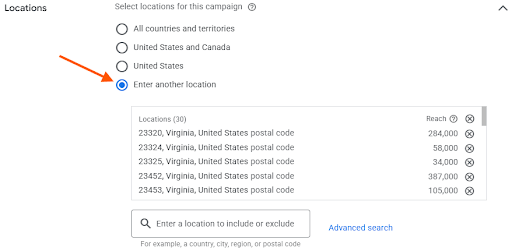
Zip Code Bidding: Don’t just target a city. Target the specific zip codes where your ideal customers live.
-
Geo-Fencing Competitors: We often set tight perimeters around our clients’ competitors. If a potential patient is at a rival service provider, your ad offering a “Second Opinion Special” can appear on their phone at exactly the right moment.
-
Ad Scheduling (Dayparting): If you are a service business, don’t run ads at 2:00 AM if no one is there to answer the phone. We sync ad spend with store hours to ensure every click has a chance to become a conversation.
The Efficiency-First Framework
This is where we differ from most agencies.
Most advertisers stop at setting a location; we focus on reducing the cost of the click through hyper-local optimization. I
n our experience, a click on a local-specific keyword (e.g., “[Service] in Cherry Hill”) or a “near me” modified keyword is almost always cheaper and more qualified than a click on a general “Service” keyword.
We prioritize these “Long-Tail Local” terms to drive down the overall account CPA.
By optimizing for the specific location, we improve the Ad Relevance score, which Google rewards with a lower actual CPC.
We aren’t just buying clicks; we are optimizing for the lowest possible cost to acquire a local neighbor.
Agency Insights: Lessons from the Trenches
After years of auditing local accounts, our team has identified several “Local Traps” that eat budgets:
1. The Radius Trap (The 0–3–7 Rule)
We often see clients set a 20-mile radius simply because they are willing to accept customers from that far away.
However, our data consistently shows that CPA often doubles after the 5-mile mark.
This happens because local searchers prioritize convenience; the further they are from your physical location, the less likely they are to convert.
To combat this, we implement “Tiered Bidding”:
-
0–3 Miles: Aggressive bidding (+50-100%) for the “inner circle.”
-
3–7 Miles: Moderate bidding for the secondary zone.
-
7+ Miles: Very low bidding (or exclusion) to protect the budget for higher-intent leads.
2. “Near Me” Saturation
Generic “service + near me” keywords have become a “tax” on small businesses.
We’ve found better ROI by targeting “Problem + Neighborhood” (e.g., “emergency AC repair in Fishtown”).
3. Weather-Triggered Urgency
Advanced local campaigns leverage weather-triggered ad copy.
By using scripts to monitor local forecasts, we can trigger ads that offer “shelter from the rain” or “AC repair for the heatwave.”
This creates an immediate psychological connection that static national ads cannot match.
GBP Optimization: The Trust Bridge
The connection between your Google Ads account and your Google Business Profile (GBP) is more than just a map pin; it is a critical trust bridge.
When these two assets are out of sync, you aren’t just losing a lead—you are actively paying to frustrate a potential customer.
-
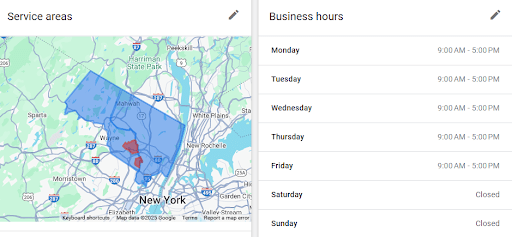
Hard-Stop Scheduling: We set ad schedules to turn off 15–30 minutes before your GBP says you close. This ensures you aren’t paying for clicks from people who will reach a voicemail or a locked door.
-
Location Extension Audits: We regularly verify that the “Google Business Profile” linked to the ad account is the correct location. For businesses with multiple branches, sending a user to a branch 20 miles away because of a linking error is a common mistake.
-
Holiday Syncing: If your business is closed for Labor Day but your Google Ads are still firing, you are essentially donating your budget to Google.
High-Converting Local Landing Pages
Your ad is a promise; your landing page is the fulfillment.
To convert a local lead, Continuity is King. * Localized H1s: If your ad targets “[service] in Cherry Hill,” your landing page H1 must say “[service] in Cherry Hill.”
-
The “Neighbor Proof” Section: Feature testimonials specifically from customers in that exact town.
-
Visual Trust: Embed a live Google Map of your location to prove you are “right around the corner.”
Measurement & Optimization
In local PPC, we move beyond the “Click.” We optimize for:
-
Store Visits: Using Google’s location services to see who walked in after seeing an ad.
-
Phone Calls: Utilizing call tracking (DNI) to attribute every ring to a specific keyword.
-
Form Completions: Measuring how many people fill out a contact form.
-
Local Remarketing: Layering geographic fences over your remarketing lists to target past visitors only when they are physically nearby.
The Bottom Line
Local PPC management is a game of timing and relevance, not just geography.
If you speak the language of the neighborhood, sync your ads with your actual operational hours, and bid with surgical precision, you can out-maneuver competitors with ten times your budget.
