

We’ve been doing Google Ads for orthopedic surgeons since 2017 and there’s one thing that stands true: when done for a practice with a good reputation and when executed optimally, it can fill your calendar.
While organic SEO is a great long-term play, it can take months or even years to see a return on your investment.
Pay-per-click (PPC) advertising through Google Ads is the only way to generate high-intent surgical leads through Google almost instantly.
(Meta Ads through Facebook and Instagram is your other option to get leads out of the gate).
If you want to grow your practice by targeting patients specifically looking for knee replacements, ACL repairs, or spinal fusions, this guide is for you.
We’ve taken the lessons learned from scaling high-stakes medical practices and applied them specifically to the world of orthopedics.
Focus on Cost-Per-Acquisition, Not Just Clicks
Most agencies will try to impress you with “clicks” or “impressions,” but these are often vanity metrics.
In an orthopedic practice, the only number that truly matters is your Cost Per Acquisition (CPA).
This is the total amount of ad spend required to get a qualified patient to actually book a consultation.
Because procedures like total joint replacements have a high lifetime value, you can afford a higher CPA than a general practitioner.
Typically, you should expect to spend between $3,000 and $12,000 per month to remain competitive in a mid-to-large sized market.
Your goal is to ensure that your ad spend is resulting in surgical cases, not just phone calls asking for directions to your office.
Navigating Healthcare Landmines
Google has very strict policies when it comes to healthcare, and if you aren’t careful, your account can be suspended.
The biggest hurdle is the ban on “personalized advertising,” which means you cannot use traditional retargeting.
You aren’t allowed to follow a patient around the internet with ads just because they looked at your “torn meniscus” page.
Additionally, mentioning certain prescription drugs or specialized biologics in your ad copy can trigger automatic disapprovals.
You also need to be wary of your landing pages; sending paid traffic to a generic homepage is the fastest way to waste your budget.
Patients searching for a specific surgery want to land on a page that addresses that surgery, not a list of every doctor in your building.
HIPAA Compliance: The Technical Barrier to Performance
You need to understand that running Google Ads in a HIPAA-compliant fashion is mandatory, but it will negatively impact your results.
Google will not sign a Business Associate Agreement (BAA) for its advertising platform, which creates a data privacy gap.
To fix this, you have two primary options that both require an investment.
The first is using a service like Freshpaint, which acts as a privacy shield between your site and Google.
This service is excellent but can cost several thousand dollars a month.
The second option is implementing server-side tagging.
This allows you to intercept data before it reaches Google and strip away any Protected Health Information (PHI) like IP addresses or names.
By “cleaning” the data, you stay compliant, even though the loss of granular data makes Google’s AI slightly less efficient at finding new patients.
Best Campaign Types for Orthopedic Practices
Not all Google Ads are created equal, and you should use a mix of strategies to dominate your local market.
Standard Search Ads are your bread and butter; they place you at the top of the page when someone types “orthopedic surgeon near me.”
You should also be using Local Services Ads (LSAs), which feature the “Google Screened” checkmark.
These ads are pay-per-lead, meaning you only pay when a patient actually calls your office.
Finally, Performance Max (PMax) campaigns can help fill the top of your funnel by showing your practice on YouTube, Maps, and the Display network.
PMax uses AI to find people who are currently in the market for orthopedic care based on their recent browsing behavior.
Mastering YouTube and Video Ads
YouTube is the second largest search engine in the world and is a goldmine for orthopedic surgeons.
Video allows you to build a level of trust and authority that text ads simply cannot match.
You should focus on two specific types of video content for your practice.
First, create “Bumper Ads,” which are non-skippable 6-second clips that build local brand awareness.
These are perfect for keeping your name top-of-mind for anyone in your area searching for “joint pain.”
Second, invest in “Patient Story” videos where a real person describes their journey from chronic pain back to an active lifestyle.
These videos should be used in Performance Max campaigns to find prospective patients while they are browsing relevant content online.
High-Converting Landing Page Development
Your landing page is where the surgery is sold, and it needs to do the heavy lifting of pre-qualifying patients.
To maximize your conversion rate, you must include several critical elements.
First, prominently display your specialized credentials, such as being a Fellow of the American Academy of Orthopaedic Surgeons (FAAOS).
Board certifications and local accolades build immediate trust with a patient who is nervous about surgery.
Second, you must mention insurance and billing transparency.
State clearly which major insurance plans you accept to prevent wasted clicks from patients you cannot treat.
Third, highlight your Unique Value Propositions (UVPs), like “Flexible Scheduling” or “Same-Day Appointments.”
Many patients choose a surgeon based on how quickly they can be seen rather than just the doctor’s name.
Finally, consider using a “Tripwire” offer, such as a Free Knee or Hip Health Risk Assessment.
This is a low-friction way for patients to engage with your practice without the pressure of booking a surgical consult immediately.
Best Campaign Types for Orthopedic Practices
Not all Google Ads are created equal, and you should use a mix of strategies to dominate your local market.
Standard Search Ads are your bread and butter; they place you at the top of the page when someone types “orthopedic surgeon near me.”
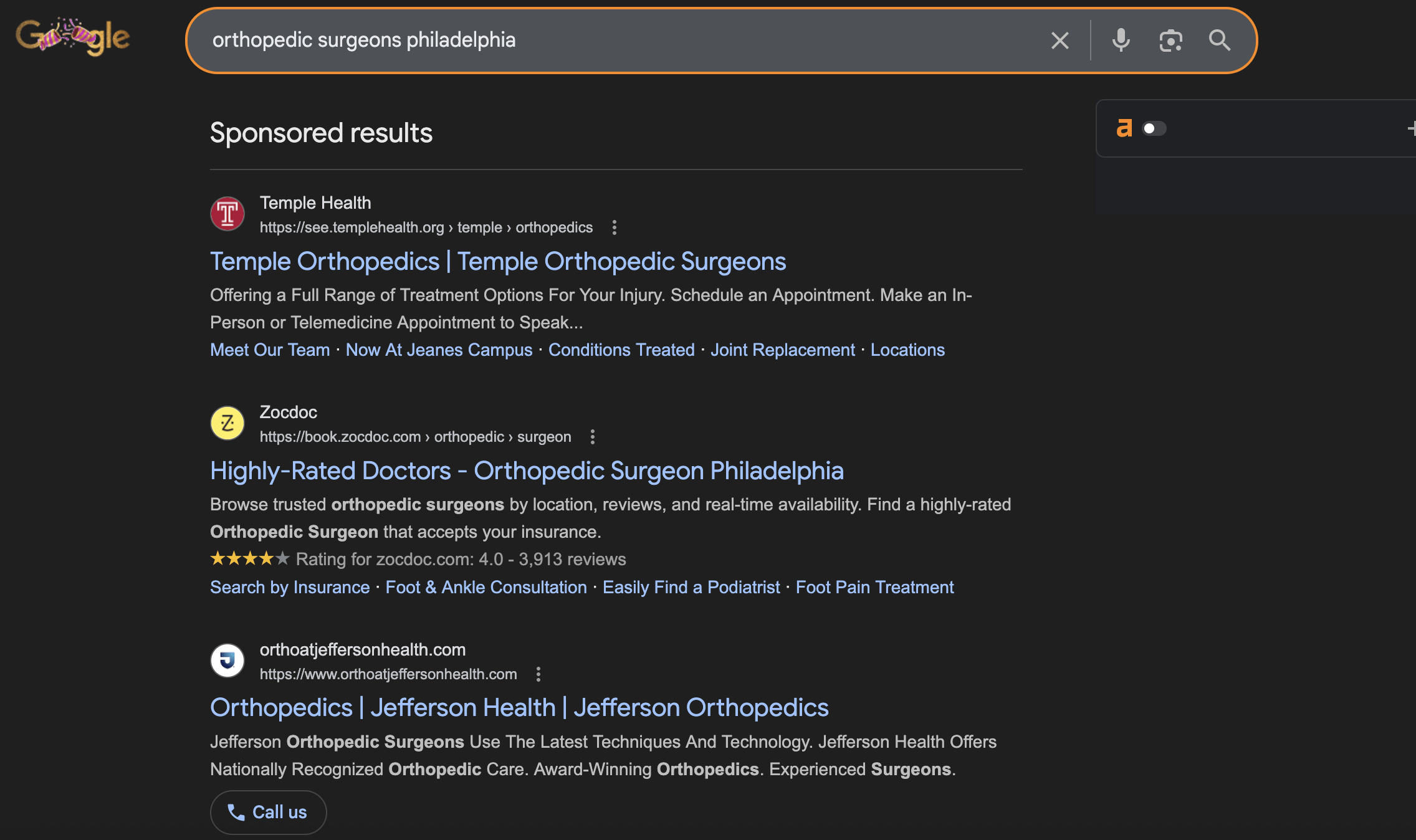
Finally, Performance Max (PMax) campaigns can help fill the top of your funnel by showing your practice on YouTube, Maps, and the Display network.
PMax is advertised as AI to find people who are currently in the market for orthopedic care based on their recent browsing behavior, but our experience is that it drives lots of spam.
Avoid Wasting Budget on the Wrong Clicks
To get the most out of your account, you need to be aggressive about how you spend your money.
Here are the 11 tactical tips we’ve learned from years of managing medical accounts.
Prioritize Mobile Traffic
Over 80% of your leads will come from mobile devices, so your mobile experience must be flawless.
Maximize Ad Strength
Use Responsive Search Ads with at least 15 headlines to let Google’s AI determine which message resonates best with patients.
Split Test Your Landing Pages
Never assume your website is “good enough.”
Test dedicated, high-converting landing pages against your service pages.
Use Bot Protection
Install a service like CleanTalk to stop spam bots from filling out your forms and wasting your daily budget.
Implement High-Level Call Tracking
Use a tool like CallRail (with a BAA) to see exactly which keywords are driving surgical consultations.
Set Ad Schedules in Blocks
Don’t just run ads 24/7.
Break your day into 3-hour blocks to see when your highest-quality patients are most active.
Aggressive Negative Keywords
Block searches for “salary,” “jobs,” or celebrity injuries so you aren’t paying for clicks from students or sports fans.
Granular Geotargeting
Target specific high-income zip codes rather than broad counties to find patients who are more likely to choose elective procedures.
Demographic Bid Adjustments
If you are hunting for joint replacements, bid higher on the 55+ age demographic and lower on younger users.
Layer Audience Data
Focus your budget on “Luxury Shoppers” or “Health and Fitness Buffs” to reach people who prioritize their physical well-being.
Test Multiple Campaign Environments
Run manual search campaigns alongside “Smart” campaigns to see which one delivers a lower CPA for your specific location.
Building a Scalable Patient Pipeline
Growing an orthopedic practice requires a shift in mindset from “buying clicks” to “investing in patients.”
By following this playbook, you can move away from the frustration of unpredictable lead flow.
Remember that the data should always drive your decisions.
If a particular zip code or surgical keyword isn’t converting after 90 days, cut it and move the budget to what works.
Success in PPC isn’t about spending the most; it’s about being the most efficient with every dollar you put into the platform
